
What if I stopped paying attention?
The news is optimized for my misery, and news diets aren't cutting it. Maybe it's time to go cold turkey.

Welcome to the weekend edition of The Experiment, your official hopepunk newsletter. If you’d like to support my work, become a paid subscriber or check out the options below. But even if you don’t, this bugga free. Thanks for reading!
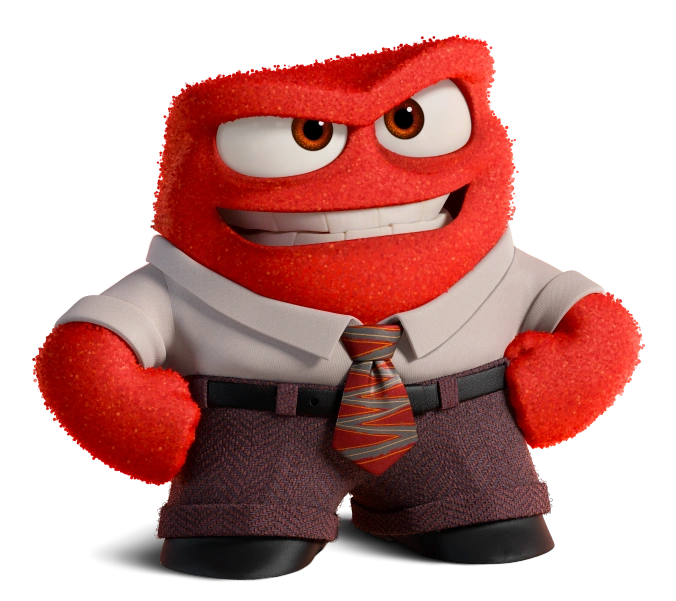
I miss being angry all the time.
During the first Trump administration, my anger simmered, always ready to boil over at anything he said or did, which was a lot. He even stayed up well into the night to provide fresh outrages when I woke, checked Twitter, and muttered invectives quietly so as not to wake my wife. But have you read the news today? Oh boy. What I wouldn’t give for some rather sad news about a lucky man who made the grade. Late-stage America humiliates the patriot and breaks the heart of a democrat, and brother, I’m both. I am sadder than I can remember being, which begs the question: What am I going to do about it?
If by “it” you’re thinking about the state of things, then I’m going to vote, march, tell the truth, and love up my people. But if by “it” you’re thinking about how I feel about seeing my country come undone, then I think I need to do what I can’t bring myself to do yet: I need to stop following the news. I’m not talking about a news diet but abstinence: deleting apps, winnowing newsletters, and generally turning off the digital ticker-tape news feed I’ve built for myself over the years.
Wait, hold on, hear me out. A lot of you are journalists, and you know how feel about you. You know I respect your job and the talent and smarts you bring to it. This isn’t personal, this is self-preservation.
What’s crawled into my cornflakes isn’t exclusively the content of the news, though most of the news these days looks like it should come with a parental warning. Reading that the American Dream—or at least the house, wedding, kids, and college that go into it—now costs almost twice as much as an American with a college degree can expect to make in a lifetime can bum a fella out. As is the news that economic indicators of bad times ahead, such as sales of Hamburger Helper, animals being dropped off at shelters, and Google searches for “help with mortgage,” are way up and rising.
What is making me consider cutting off my news consumption is that the news is designed to upset me. Where and how I encounter the news are now experiences optimized to engage me by eliciting negative emotional reactions in order to make me click on a story and then keep me on the app.
Recently I asked a newspaper journalist if they1 were using AI at work. “Don’t tell my editor,” they said, “but I use it to write better headlines.” What “better” meant was clear: more engaging. More clicks meant their stories drove more traffic, which meant higher digital ad revenues, which translated to job security in the next round of layoffs. And the easiest way to get a click is to arouse someone’s negative emotions, which means that the news industry incentivized this reporter to provoke anger, fear, or any other horseman of the apocalypse regardless of the positive or negative content of the article.
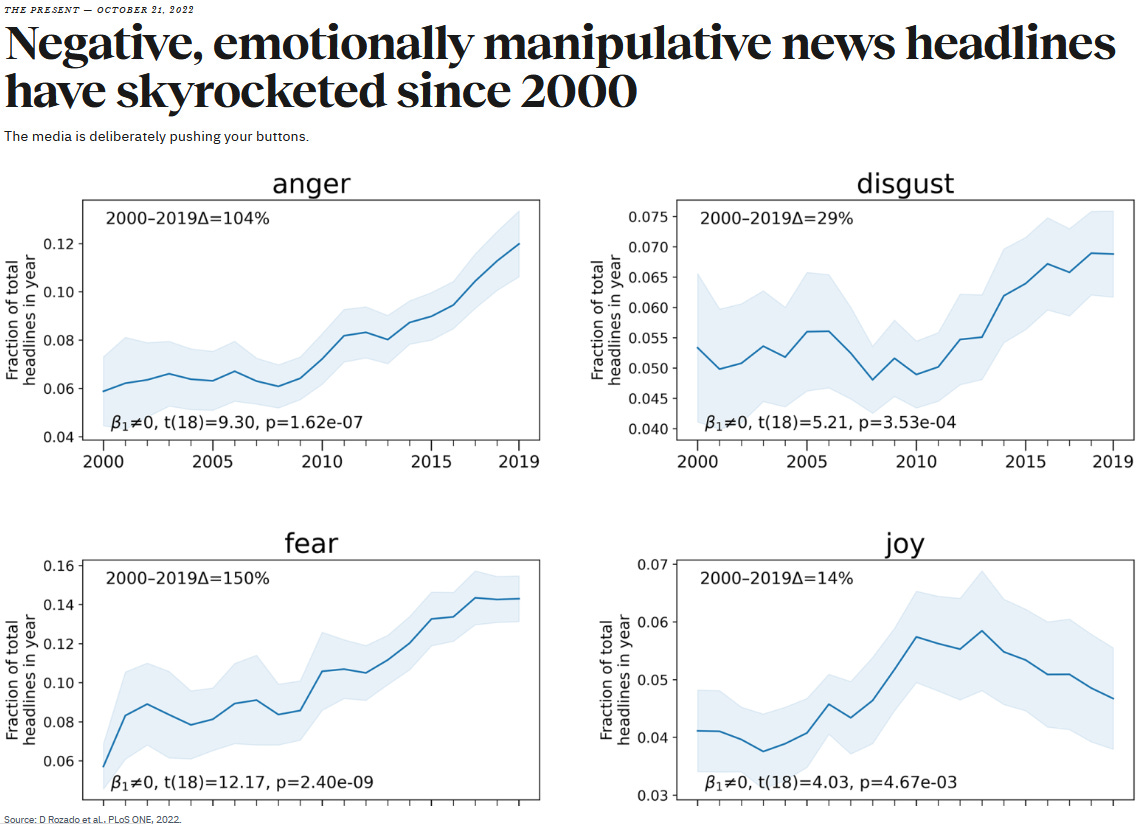
This practice has become endemic in the news media. A 2022 study of 47 American news publications found that since 2000, headlines inducing anger increased 104%, fear 150%, disgust 29%, and sadness 54%. And this was consistent across the ideological spectrum.
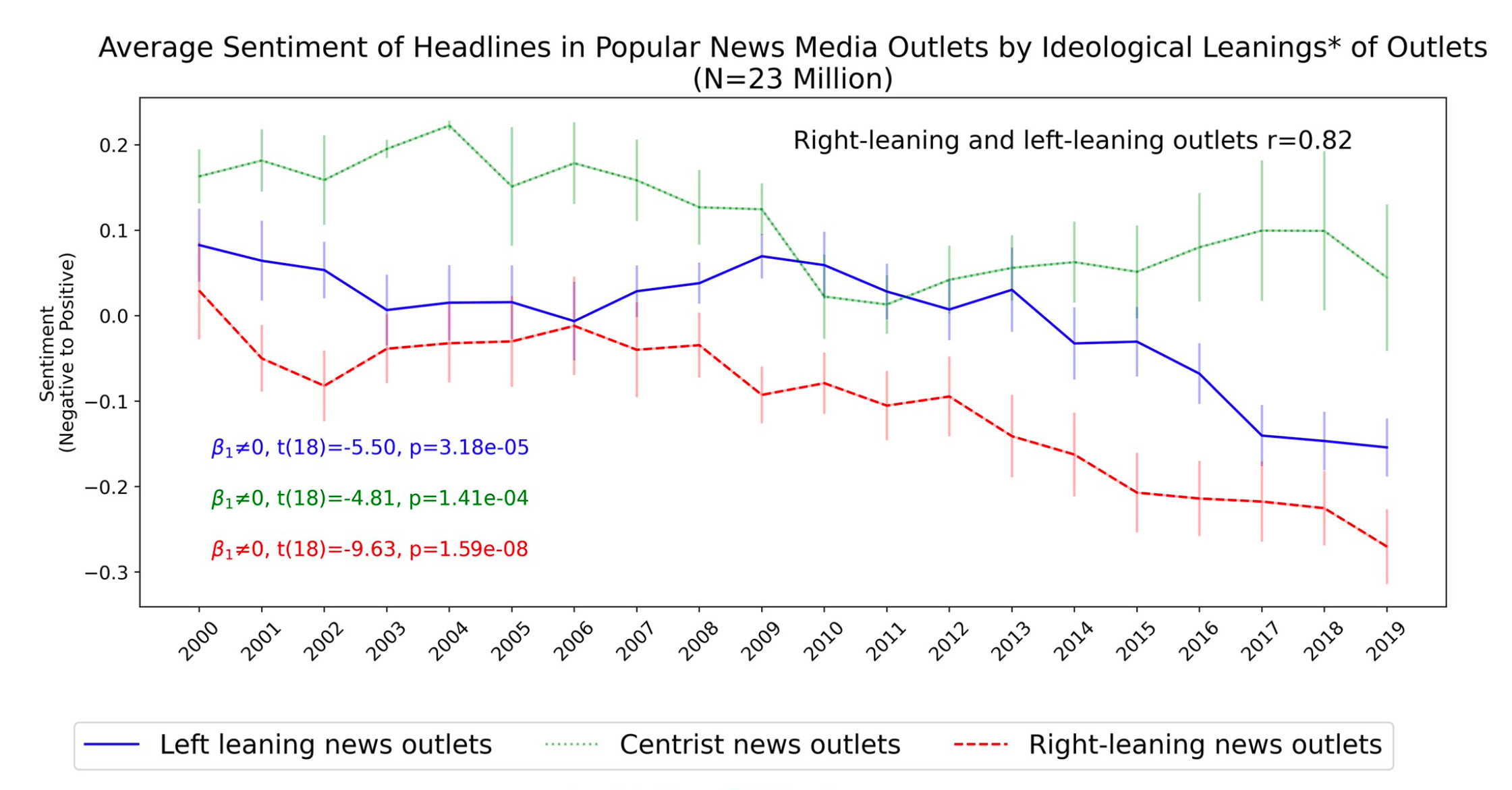
You want to know what’s really sad about this? This study covers the lives of my two sons. They have only known a world in which things—at least insofar as headlines represent the general and evolving state of things—increasingly are engineered to make them feel bad. There were times in the last two decades-plus when we felt hopeful, when things looked like they were coming around. But the portrayal of these times was grim on a good day, and has only gotten worse.
The researchers who studied the headlines noted that during the last decade, new technologies emerged that allowed editors and journalists to iterate headlines not to be more accurate but to piss you off more or to thoroughly bum you out.
“Thus, a perverse incentive might have emerged in which news outlets, judging by the larger reach/popularity of their articles with negative/emotional headlines, started to drift towards increasing usage of negative sentiment/emotions in their headlines,” they wrote.
Confession: I used to do this with this website, and I noticed an uptick in the open rate, shares, and multiple reads. I only stopped because trying to guess which collection of words would score the highest started to annoy me. It wasn’t because I was intentionally upsetting you to boost my traffic. The system’s not optimized for empathy.

Another way the news is making us miserable is where we find it. When we’re actively seeking it out, we’re still more likely to turn on a television or go to a news website, according to a study done this year by the Global Strategy Group. If only active news consumers had voted, we’d all be arguing about President Kamala Harris right now.

But we also consume news passively, like when you’re messing around on Facebook and scroll past a news article your auntie posted with her own recontextualizing commentary. Social media, not “the news,” is where half of Americans get their news passively, including huge majorities of young people.
Passive news consumers preferred President Donald Trump over Kamala Harris in the 2024 election, but a bare majority now say they disapprove of him. One place these tuned-out viewers still go: YouTube, which 80% — and 95% of 18-to-29-year-olds — said they used at least weekly.
The reason journalists have the technology to optimize our misery is because social media companies invented it to keep you locked into your feeds, and they don’t call it doomscrolling because it makes you happy.
Meta is actively helping self-harm content to flourish on Instagram by failing to remove explicit images and encouraging those engaging with such content to befriend one another, according to a damning new study that found its moderation “extremely inadequate”.
Danish researchers created a private self-harm network on the social media platform, including fake profiles of people as young as 13 years old, in which they shared 85 pieces of self-harm-related content gradually increasing in severity, including blood, razor blades and encouragement of self-harm.
The experience of encountering news optimized to upset you in digital environments engineered to make you unhappy is increasingly inescapable. News websites used to replicate the experience of reading a newspaper, shepherding you to the right section before you settled on an article. Now the apps let you scroll past successively more depressing and enraging headlines. By replicating a social media feed and infusing it with immiserating headlines without the interstitial relief of a comedian, a cooking video, or a cooking video about another cooking video, news apps have become a reliably horrible experience delivering a product that consumers of all ideological stripes distrust in record numbers.
This is not to say that the news media provides no value. If you divide Americans into three groups defined by how actively and frequently they seek out news, so-called “high attention” news consumers are more likely to oppose sending the U.S. military to quell protests in American cities, more likely to think there are important differences between parties, and most hip to our democracy being under attack. Those who pay the least attention to the news support Donald Trump and think Democrats are the party of extremists. I’m careful not to confuse correlation with causation, but I don’t think we can rule out the possibility that staying informed makes you liberal.
But being liberal is also correlated with being unhappy, a topic Derek Thompson dove into recently.
In one representative analysis, the 2022 paper “The Politics of Depression,” published by the journal Social Science & Medicine–Mental Health, the epidemiologist Catherine Gimbrone and several coauthors showed that young progressives in high school are significantly more depressed than conservatives. As the chart below indicates, liberal girls have for many years self-reported a higher depressive affect score than conservative girls, and the gap has grown moderately over time.
Using data from the Monitoring the Future survey of more than 85,000 students between 2005 and 2018, Gimbrone and her co-authors showed that large gaps have opened up between liberal girls and other groups on negative self-esteem and self-derogation (or, feelings of intense self-criticism). Conservative boys reported the smallest changes, while “female liberal adolescents without a parent with a college degree reported the worst internalizing symptom scores,” they concluded.
Maybe ignorance is bliss. Certainly, the world’s going to keep spinning whether I read the news today or not, but choosing to opt out of the news cycle makes me feel a little queasy, as if doing so would be irresponsible as a citizen. Ryan Holliday has written often about the importance of reading history and keeping one’s head during times like these. Maybe there are better alternatives to ignorance and healthier ways to responsibly occupy one’s mind while the rest of the world is losing theirs.
I’ve been paying too close attention for too long now, and it’s come at a price. There’s a stack of books that’s calling my name. I’ll report back and tell you how it’s going.
Jason Stanford is a co-author of the NYT-best selling Forget the Alamo: The Rise and Fall of an American Myth. His bylines have appeared in the Washington Post, Time, and Texas Monthly, among others. Email him at jason31170@gmail.com.
Further Reading
The Fourth Estate Has Fallen

Welcome to the weekend edition of The Experiment, your official hopepunk newsletter. If you’d like to support my work, become a paid subscriber or check out the options below. But even if you don’t, this bugga free. Thanks for reading!
Why Trump is beating the Epstein rap

Welcome to the weekend edition of The Experiment, your official hopepunk newsletter. If you’d like to support my work, become a paid subscriber or check out the options below. But even if you don’t, this bugga free. Thanks for reading!
The Beclowning of America

Welcome to the weekend edition of The Experiment, your official hopepunk newsletter. If you’d like to support my work, become a paid subscriber or check out the options below. But even if you don’t, this bugga free. Thanks for reading!
We have met the ruin of AI, and it's us

Welcome to the weekend edition of The Experiment, your official hopepunk newsletter. If you’d like to support my work, become a paid subscriber or check out the options below. But even if you don’t, this bugga free. Thanks for reading!
Jason Stanford is a co-author of the NYT-best selling Forget the Alamo: The Rise and Fall of an American Myth. His bylines have appeared in the Washington Post, Time, and Texas Monthly, among others. Email him at jason31170@gmail.com.
We set up a merch table in the back where you can get T-shirts, coffee mugs, and even tote bags now. Show the world that you’re part of The Experiment.
I am using a gender-neutral pronoun to add a layer of protection to the journalist’s identity.
I appreciate your post, Jason. I, too have thought about swearing off the news but I just can't bring myself to do it. I feel it's my duty - as a citizen of the U.S. and the world, and a member of the human race. But it comes at an emotional cost, for sure.
It's no surprise to me that active consumers of news were more likely to support Harris. The only way to get at the truth is to be actively engaged in the act of knowledge and truth seeking. Likewise, "liberals" being less happy than "conservatives" is no surprise... particularly as they are likely to be active consumers of news and truth.
I question whether anyone who follows and understands what's going on around them in these times can be happy. Climate change. Wars. Democracy in decline, not just in the U.S. but around the world. Knowledge may be power, but it's also really depressing.
A little personal story.
A few years ago I found myself in the horrible position of having to rebuild my life. Best friends, Mom, and spouse all passed way within 13 months; had previously moved to be closer to my husband's family (before he and my Mom died) and that turned out not so great for me; my longtime employer and I parted ways within a year of the last of the deaths; and more. Biden's inauguration day was the same day my spouse went into the hospital (COVID) never to come home. But at least Biden was President; couldn't imagine what I would have done if Trump had been elected then.
Fast forward, and personally things are in a really great place but obviously the world is a complete sh*tshow. Ironic how things work.
After my disabled daughter and my wife died weeks apart last winter I found myself unable to keep focused attention long enough to read books. I threw myself into cleaning out the house, getting rid of patient-care supplies and equipment, wheelchairs and such. I could work until I was tired of it, quit when I wanted and stop for a moment of pawing through memories when needed.
Eventually I dug out some familiar old detective novels to reread and regained my ability to get offline onto dead tree reading when needed. They are very different.