
Same Coal Mine, Different Canary
When they start saying the rules don't apply, that's when bubbles pop

Welcome to the weekend edition of The Experiment, your official hopepunk newsletter. If you’d like to support my work, become a paid subscriber or check out the options below. But even if you don’t, this bugga free. Thanks for reading!
In 1995, they said the Internet—back then we called it “the web”—was going to be so big that some day every business would have its own website. Investors were so hungry to put money into dot-coms, or startups that did most of their business online, that they held speed-dating cattle calls in Silicon Valley in which prospective founders would make their pitches one after another, often leaving with a big check. After no time at all, the startup would go public trading on the NASDAQ at valuations far above their fundamentals. It made no sense, but people were making so much money that few asked questions.
They called it the Dot-com boom, and if you weren’t making money founding a startup or working for one, then you were buying shares of AOL, Cisco, Microsoft, Pets.com, and the like and congratulating yourself on your savvy as the stocks rose. How easy was it to make money then? On a tip from her pastor, my mom bought a stock that immediately grew like a weed. The next Sunday, she went to thank him, only to find out that she’d misunderstood him and bought the wrong stock. That’s how easy it was. You could buy the wrong stock and do fine.
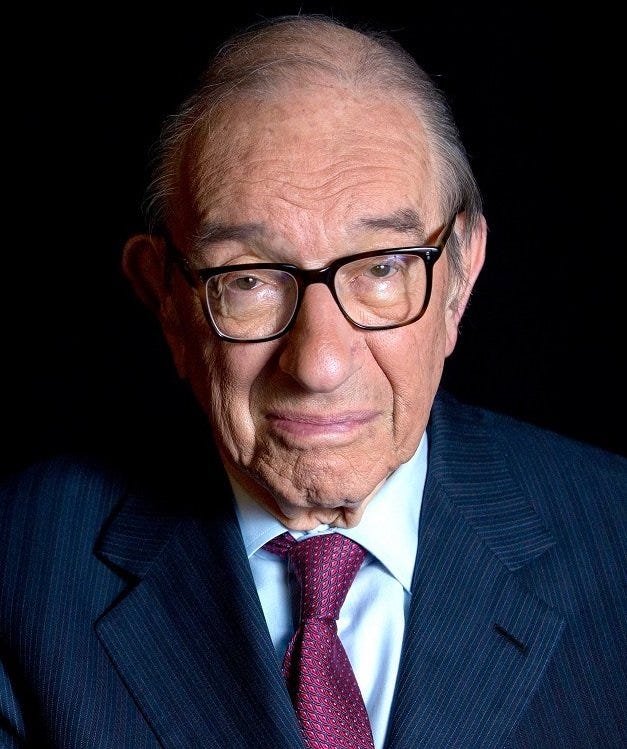
After a couple years of this, a canary cleared its throat, only it was Alan Greenspan, then chairman of the Federal Reserve, not a canary. In fact, Greenspan would have scoffed if you’d suggested he was a canary because the point of his speech was to deny the existence of a coal mine at all. What Greenspan said on Dec. 5, 1996, in accepting an award from a right-wing think tank, was that everything was fine, excellent, quite well, thank you, except…
“Clearly, sustained low inflation implies less uncertainty about the future, and lower risk premiums imply higher prices of stocks and other earning assets. But how do we know when irrational exuberance has unduly escalated asset values, which then become subject to unexpected and prolonged contractions as they have in Japan over the last decade?”
What the Fed Chair says matters to Wall Street. If Greenspan blew his nose in public, the stock in Kimberly-Clark, which owns Kleenex, would rise. Right after his speech, Reuters news service ran this headline over the wire: “Fed must be wary when irrational exuberance affects stocks, assets.” Financial types interpreted Greenspan’s facial expressions for clues, so when he said that he was including these crazy stock market valuations as an economic indicator in setting interest rates, Wall Street took the hint, and NASDAQ tanked.
Actually, it only dropped 2% the next day, which was a Friday. “A Buried Message Loudly Heard,” went a New York Times headline. Wall Street spent the weekend pondering Greenspan’s intent, ultimately choosing an interpretation that kept the party going. The NASDAQ index rose that Monday, closing at 1,316.26. For the next three-plus years it kept on going up another 283.56%. Everyone from Smith Barney to my mother embraced the illusion that this time was different and the normal rules didn’t apply.
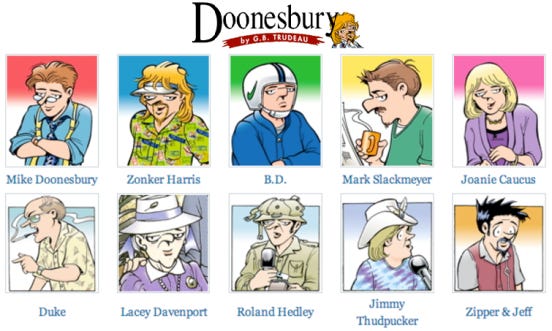
Actually, now that I think about it, maybe the canary in that coal mine was Doonesbury, a political comic strip that had one of its characters brag about how much money his startup was losing. His daughter, confused, wonder if losing money weren’t a bad thing only to be patted on the head and told that “Internet companies are supposed to lose money. That’s why they go public.” (“Looking to Doonesbury as an Economic Indicator” was the Times headline.
That was the puzzle of it; the stocks kept going up as losses grew, and we were to believe that this is just how things worked now. Which they did until the dot-com bubble popped on March 10, 2000, which means for almost four years exuberance reigned irrationally after Greenspan warned it was so. I sympathize. It must be hard to listen to reason when doing so would exclude you from rolling around in all that money. There’s even a logic to it: If real people are making real money on the stock market in a way that business fundamentals say should not be happening, maybe the business fundamentals no longer apply. The Internet, we were told, would change everything.
It did, but profits and losses still mattered, and for the next two-plus years the stock market corrected itself until prices and profits held hands again.
Since then, I’ve been sensitive to both the Greenspanish Cassandras and the Doonesburian canaries, like my arthritic ankle hurting when the weather turns. I heard it in 2005, when David Lereah, the chief economist for the National Association of Realtors, promised that the housing boom would experience a “soft landing” and avoid any recession, three years before 2008’s terrifyingly sudden Great Recession. Fourteen years later, the Dallas Fed warned of a new housing bubble characterized by “signs of real house-price exuberance.” (The analysis used a form of the word “exuberant” 13 times. They did everything but underline and bold-face it.)
Which brings us to the AI boom that might be a bubble. Arguing that it’s a bubble are folks including journalist-podcaster Derek Thompson and investor-business professor-podcaster Scott Galloway, who point out that the stock prices for AI companies—which, by the way, are driving the S&P 500 nearly all on their own—are once again divorced from those nagging business fundamentals and other realities such as power generation capacities. Each made a great case for AI’s bubbliciousness late in 2025.

Since which time the S&P 500 has shot up another 20%, and seemingly smart people in publications called Investing.com and yahoo!finance tell us, “Markets may increasingly need a new set of economic gauges” and that “long-held definitions of ‘safe’ and ‘expensive’ stocks are being turned upside down.” What does it mean for “long-held definitions” to be reversed. Hell if I know, because I suspect those words don’t mean anything.
But that first bit bears our attention. The full quote is, “Markets may increasingly need a new set of economic gauges to measure AI adoption, productivity transmission, and workforce integration alongside traditional indicators such as payrolls and GDP.” Now we’re being told that how much these AI companies are using AI is a brand-new business fundamental, which to me sounds a lot like Doonesbury bragging about how much money his dot-com was losing.
Some AI companies are doing what’s called “tokenmaxxing,” or making how many AI tokens1 an employee is using—in effect, how much they are using AI—a metric of their performance. Not whether they’re doing anything that yields a single useful result or makes a damn dollar, just how many hamster wheels they can keep spinning.
We’re starting to see smoke coming from the engine. Uber’s CEO recently made headlines by revealing that they’ve burned through their AI budget for the year and have not seen commensurate outcomes. “It's very hard to draw a line between one of those stats and, ‘Okay, now we're actually producing 25% more useful consumer features,’” he said, describing the realization as “head-exploding.”
Uber is not alone, as Silicon Valley companies dial down their AI use after not seeing the ROI. Meta has taken down its “Tokenmaxxing” leaderboard, Microsoft has pulled most employees’ Claude Code licenses, and an Nvidia exec recently said, “The cost of compute is far beyond the costs of the employees.” For the most part, the spending on AI (which, again, is driving the gains in the S&P 500) are not yielding returns. In other words, they’re lighting money on fire, but this time with fancy new robots.


And yet the S&P 500 went up 5.3% in May alone. “Irrational Exuberance 2.0 Has Arrived on Wall Street” was the Motley Fool headline.
Maybe I’m not looking at this the right way. Maybe it’s different this time. Maybe AI, a truly revolutionary tool, requires a corresponding revolution in business metrics. Maybe these robots will create enough economic activity on their own to free humanity of toil and want, freeing us to live lives of meaning, human communion, and exploration.
Maybe I’ll play third base for the Baltimore Orioles in Toronto tonight.
A reckoning is coming, folks. I don’t know when. Heck, the dot-com boom lasted years after Greenspan called them on their irrational exuberance, but when the bubble popped, NASDAQ lost three-quarters of its value. I’m sure you’re a better person than I, but speaking for myself, I think I’d enjoy watching Elon Musk lose three-quarters of his net worth. It might be nice for things to be brought into alignment with reality.
Jason Stanford is a co-author of the NYT-best selling Forget the Alamo: The Rise and Fall of an American Myth. His bylines have appeared in the Washington Post, Time, and Texas Monthly, among others. Email him at jason31170@gmail.com.
Further Reading
Stop Using AI to Write

Welcome to the weekend edition of The Experiment, your official hopepunk newsletter. I took the last two weekends off because of travel schedules, and while I don’t think I have a free weekend this summer until August, I’ll get better about getting things done. The essays are piling up in my head and I need to get them out. If you’d like to support my w…
We have met the ruin of AI, and it's us

Welcome to the weekend edition of The Experiment, your official hopepunk newsletter. If you’d like to support my work, become a paid subscriber or check out the options below. But even if you don’t, this bugga free. Thanks for reading!
Welcome to the "Patagonia vest recession"

I don’t know if it works this way for everyone, but when I just typed “Are we” into the Google search bar, it autofilled “in a recession.” Apparently I’m not the only one asking that question. The Federal Reserve is hoping to raise interest rates enough to slow inflation but not so much to slow economic growth so much that we go into a recession. Even t…
This is the worst recession ever. For starters, it's not even a recession.

The other day, more than 3,000 miles beneath our feet, Earth’s inner core started spinning in the wrong direction. Normally, we’re all spinning on Earth’s axis from west to east, and the core does right along with it, which frankly I don’t think is too much to ask. Scientists called this “
Buy the book Texas Lt. Gov. Dan Patrick banned from the Bullock Texas History Museum: Forget the Alamo: The Rise and Fall of the American Myth, cowritten by yours truly.
We set up a merch table in the back where you can get T-shirts, coffee mugs, and even tote bags now. Show the world that you’re part of The Experiment.
A token is a unit of information for AI. The number of tokens in Forget the Alamo, for example, varies AI model, because different models split words differently:
OpenAI (GPT-4 / GPT-3.5): 4 tokens (Tokens: “Forget”, “ the”, “ Alam”, “o”)
Anthropic (Claude): 4 tokens (Tokens: “Forget”, “ the”, “ Ala”, “mo”)
Google (Gemini): 3 or 4 tokens (Tokens: “Forget”, “ the”, “ Al”, “amo”)
Llama 3: 4 tokens (Tokens: “Forget”, “ the”, “ Al”, “amo”)
Like most things in tech, clearing up confusion reveals something banal and boring.
"Maybe it’s different this time."
Yes, and... This brings to mind a modified version of the Anna Karenina principle, something like "Each bubble pops in its own unique way."
One of the hardest parts about this from the side of retail investors is that much of the returns in a bubble accrue at the very end. Which is to say that, from an individual perspective, it's rational to stay in (until its not), and it's irrational to "sit out" entirely.
"The Big Short" details the lovely object lesson of market timing in Michael Burry, who's investment fund in credit default swaps struggled to stay solvent in 2007 amid mounting losses as markets continued to climb. History proved him right and he came out ahead, but he fought hard to make it through. As the saying goes, "the market can stay irrational longer than you can stay solvent".