
The Dumbest Thing in Minnesota Right Now
History doesn't repeat, but it's rhyming in 3-part harmony in Minnesota right now

Welcome to the weekend edition of The Experiment, your official hopepunk newsletter. If you’d like to support my work, become a paid subscriber or check out the options below. But even if you don’t, this bugga free. Thanks for reading!
The Russians have sayings for almost any situation. There’s “when the crawfish whistles on the mountain,” meaning never. Then there’s “the horse hasn't rolled,” for “I haven't even started yet.” My favorite is the self-evident “If you’re scared of wolves, don’t go in the woods.” The Russian language has a talent for finding the absurdity in cruelty and poetry in the banal. By turns monstrous and loving, Russia is well-served by its mother tongue.
I fear, though, what idiom Russia would create to encompass the absurd cruelty in Minnesota. No, I’m not referring to the by-now ordinary cruelties inflicted daily on Minneapolis. There is no poetry in shooting a mom in the face and then calling her a “f*cking b*itch,” only an ordinary act of unaccountable, state-sponsored violence. There is nothing absurd about lying about it, either. For them, that’s just вторник. In Putin’s Russia, which apparently is aspirational for this administration, it’s always Tuesday, and there are no tacos.
No, there’s a specific thing happening in Minnesota, and in fact in Arizona, Michigan, New Mexico, Iowa, Oregon, and Washington, as well. It reminds me of Russia’s cocktail of absurd cruelty so much so that I was surprised I couldn’t find an appropriate Russian idiom to illustrate it. The closest I could come is “crying situation,” when things are so bad you have to cry.
Here’s what’s going on: ICE, which is supposed to be rounding up undocumented immigrants and sending them whence, has arrested Native Americans in Minneapolis and sent them to Fort Snelling, a Civil War-era concentration camp.

Mark Twain wrote, “History doesn’t repeat itself but it often rhymes.” Right now it’s rhyming in three-part harmony. Rounding up Native Americans and tossing them into prison camps is not new. At all.
In fact, it’s an old American tradition that dates back to the original American bad guys—the Puritans of Massachusetts, they of the scarlet letters and witch trials—and later, our original good guys, the Pilgrims of Plymouth, the apocryphal originators of the constitution, freedom of religion, and Thanksgiving. Sad to say, the Pilgrims are getting unearned credit there, though the Puritans deserve the disfavor they earned for being history’s humorless scolds. And while we remember the Pilgrims and Puritans differently today, back then both were guilty of incarcerating Indians.
While both the Plymouth and Massachusetts colonies promised in their organizing charters to covert the native heathens to Christianity, it wasn’t until more than two decades after the Mayflower dropped anchor in Cape Cod that they did anything about it.
This was a few years after the Pequot War, during which the colonists had burned the Indians’ shelters in Mystik, killing all but seven of the more than 700 inside, mostly the elderly, women, and children. Those seven, plus a couple hundred Pequot who had surrendered elsewhere and those captured in the remaining months of the war, were either sold into slavery in Barbados or, in the cases of women and children, divided among colonists. Puritan John Winthrop—the Model of Christian Charity preacher who first articulated the image of his colony as a “city upon a hill”—kept a woman named Monomotto and her children because she had saved the lives of two captured colonial women. Even Roger Williams, as good a guy in American history as there ever was, kept a boy he had “fixed mine eye on.”
John Winthrop—the Model of Christian Charity preacher who first articulated the image of his colony as a “city upon a hill”—kept a woman named and her children.
John Eliot, a preacher in Roxbury, watched all this happen, and after the war he decided to make a sort of peace. He can’t exactly be described as “enlightened” by our standards, but perhaps by their standards, when the word “heathen” got a lot of use in early colonial writing, he was. Some colonists even thought that Indians were “degenerate” leavings of the ten lost tribes of Israel. But that didn’t mean their souls couldn’t be saved, and Eliot was among the first to try.
Whether the Indians were interested in abandoning their own belief systems for the God of the plague and gunpowder was another matter. Eliot thought they were “so stupid and senseless” because they didn’t even ask about salvation. The Massachusetts Colony had successfully lobbied Parliament to support the Society for the Promoting and Propagating of the Gospel of Jesus Christ in New England, and an Indian college was built at Harvard. Wrote one 20th-Century historian, “Strangely, most of the Indians showed no gratitude whatever.” At least one tribal leader saw the stakes: “No! We have lost most of our lands, but we are not going to become the white man’s servants.”
“We have lost most of our lands, but we are not going to become the white man’s servants.”
There were incentives beyond eternal salvation. For those Native Americans who converted to Christianity and prayed with the Puritans, they could live in awkward peace with the English. Eliot, who they came to call the “Apostle of the American Indian,” converted about 1,100 Massachusetts natives who were called then and remembered today as “Praying Indians.”
The Indians who resisted stayed in the fight against the slow-motion gentrification that was the bleeding edge of genocide. To tell the truth, it was the sachems, or tribal leaders we used to call “chiefs,” who kept selling tribal land to the European settlers. The money and manufactured goods they received in exchange for land boosted their short-term political standings at the expense of their long-term security. Soon, the line between tribal and colonial land was blurred. Indians and colonists would do business, and colonists would even start greeting Indians with “netop,” or friend.
Things were tense and only became worse until, after a botched land swindle, murder, and show trial, a war broke out. King Philip’s War threatened to do what the colonists had always feared. Namely, the surrounding tribes would put aside their political and economic rivalries and drive the outnumbered colonists into the sea. In this us-or-them, English-versus-Indian nightmare, the idea that Praying Indians would be living among them was unacceptable. Sure, they went to the same church and prayed to the same God—these were Harvard men, sort of, right?—but they were Indians. They could turn on them at any time.
“there to remain and not to depart from there … upon pain of death”
So the Puritans rounded up all their Praying Indians and plopped them onto Deer Island without adequate food, water, or shelter for the winter. The Pilgrims in Plymouth did the same with their Praying Indians, sending theirs to Block Island, “there to remain and not to depart from there … upon pain of death.” Over the winter, hundreds died of starvation, exposure, and sickness, much like the original colonists would have done in 1621 had the Indians not shown them how to use fish to grow corn, among many other strategic kindnesses that were coming back to bite them in the butt.
The war lasted another year, after which a quarter of the Indian population had died and a tenth had escaped west. And though the English colonists only won the war by adopting Indian military tactics and fighting alongside Indian allies, the victorious colonists saw all Indians as potential threats. A thousand Indians, including the Praying Indians, were sold into slavery into the West Indies in a Reverse Middle Passage.
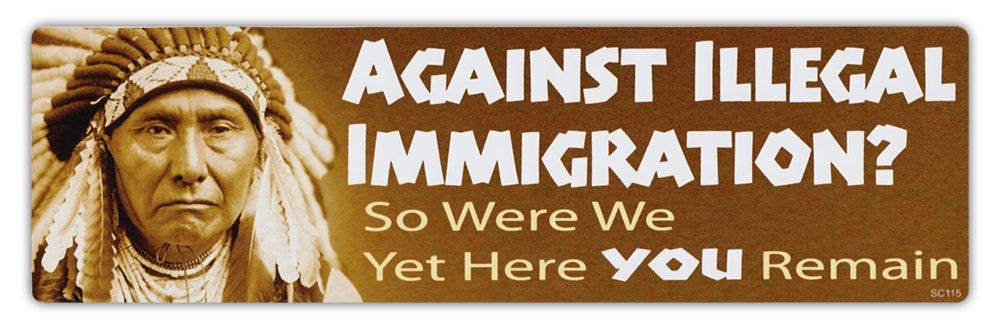
The Dakota War in 1862 didn’t start because of gentrification but something worse. The eastern Dakota bands who had signed a treaty with the United States were starving. Corrupt federal agents kept the Dakota-Sioux from receiving the food and provisions they’d been promised by the treaty. Four Dakota men murdered Minnesota settlers in a raid to steal chicken eggs, so trial leaders attacked the Lower Sioux Agency where the federal administrators worked.
Fighting lasted six weeks. Abraham Lincoln ordered 38 Dakota Indians hanged. Present-day activists from the tribe that originally helped the Mayflower crew say that President Lincoln made Thanksgiving a holiday to improve relations with Native Americans.
“It was propaganda,” explained the activist. “It was to try and build this event so that you could have a deeper narrative about community building and coming together in shared brotherhood and unity.”
Thanksgiving’s link to the 1862 mass execution is far from settled history. What is known for certain, however, is that those rebellious Dakota Indians who were not killed were interred on Pike Island below Fort Snelling where, following the script, they were not fed adequately or treated humanely. Those who didn’t die there were shipped out of Minnesota.

Reducing what is happening to absurd cruelty neglects how profoundly stupid this is. An economically illiterate president imposing tariffs is stupid. Telling people that affordability—a problem acutely felt on the micro level—is a political hoax is stupid. To the list of gaspingly stupid things that happen so often as to make the idiotic ordinary, we now add this: The most-obvious secret police in the history of secrecy and policing, in seeking those who are here illegally, have begun arresting those to whom the term “illegal immigrant” least applies.
I had a Russian teacher who taught that poetry is what you lose when you translate the text, but I gotta hand it to them: ICE loses nothing in translating Russia’s tactics to American practice, not the cruelty, not the absurdity, and not the flaming Cheetos stupidity.
I did end up finding a quote that applies here, and not in Russian but in French. “When war breaks out, people say: It won't last, it's too stupid,” wrote Albert Camus. “And war is certainly too stupid, but that doesn't prevent it from lasting.”
We are going to be in this fight for a while longer, but now we know something: We could not possibly underestimate how dumb, absurd, cruel, and stupid they are willing to appear.
Jason Stanford is a co-author of the NYT-best selling Forget the Alamo: The Rise and Fall of an American Myth. His bylines have appeared in the Washington Post, Time, and Texas Monthly, among others. Email him at jason31170@gmail.com.
Further Reading
How the Pilgrims Killed Christmas

Welcome to the weekend edition of The Experiment, your official hopepunk newsletter. If you’d like to support my work, become a paid subscriber or check out the options below. But even if you don’t, this bugga free. Thanks for reading!
Count Your Blessings

Feels wrong to quote The Police when police are starting riots, but when the world is running down, you make the best of what’s still around. Today, that means focusing on the good and the doable. For the good, we have Jack Hughes’ long-overdue look at
Advice from a Nazi Dissident

Welcome to the weekend edition of The Experiment, your official hopepunk newsletter. If you’d like to support my work, become a paid subscriber or check out the options below. But even if you don’t, this bugga free. Thanks for reading!
"Agents cut off her wedding ring..."

Welcome to the weekend edition of The Experiment, your official hopepunk newsletter. If you’d like to support my work, become a paid subscriber or check out the options below. But even if you don’t, this bugga free. Thanks for reading!
We are all Lear's Fool
About the only higher powers I’ve consistently believed in were gravity and Buck Showalter, so I was a little surprised when my ears pricked up when listening to Pete Holmes’ podcast and he went off on a jag about how we are not loved by God, but we are God’s love. I imagined us as glowing manifestations of love with no barriers separating us from the e…
Buy the book Texas Lt. Gov. Dan Patrick banned from the Bullock Texas History Museum: Forget the Alamo: The Rise and Fall of the American Myth, cowritten by yours truly.
We set up a merch table in the back where you can get T-shirts, coffee mugs, and even tote bags now. Show the world that you’re part of The Experiment.