
Why Trump Can't Be Debunked
How Instagrammable weddings made me understand why Trump's lies work

Welcome to the weekend edition of The Experiment, your official hopepunk newsletter. If you’d like to support my work, become a paid subscriber or check out the options below. But even if you don’t, this bugga free. Thanks for reading!
Earlier this year, an Indonesian social media account posted a mashup of elaborately choreographed wedding videos and behind-the-scenes footage of how they can be seamlessly staged to produce something resembling an OK Go music video rather than an actual wedding. One gets the impression, perhaps ungenerous, that the point of a wedding isn’t the ceremony but to come away with social media content. “Young generations now optimize for planned remembrance rather than enjoyment of the moment,” commented someone from Southern California.

Look, we all take and post vacation pictures. In an era when 35% of us get travel tips and vacation ideas (OK, envy) from reels on social media (“Social media is the new travel agent,” writes Axios), optimizing IRL experiences for social media content is becoming a growing business aimed at tourism destinations. Now, vacation spots aren’t just showing what you’ll do when you’re there; they’re showing you how it’ll look on social media. For many, the experience is not the result. It’s the work we do to produce what is becoming for many the point of doing anything: online content. Life is just the behind-the-scenes labor necessary to produce the movie. Exploration became travel, which became tourism. Now for many it is the recording of a staged performance of travel.
It’s not just travel, of course. How many of us have posted a picture of us with a comedian after a show? A skillfully plated dinner? A night out with friends? A child’s academic progress and, it follows, our faithful witness thereto? I’ve done all of these. And when I don’t, I feel like I failed to complete the task.
Life is becoming a collection of what historian Daniel Boorstin called “pseudo events,” or a planned, manufactured occurrence designed primarily for media coverage and public consumption rather than arising spontaneously. Examples include photo ops, reality television shows, and, lately, more and more of what used to be the most mundane events in life turned into engaging content because these share “the most momentous characteristic of the pseudo-event: for most people it [is] actually more vivid and more impressive than the spontaneous original.”
Having worked at McDonald’s was part of Kamala Harris’ political backstory, her log cabin, her humble beginning. The only problem, if you can call it that, is that no records existed that she worked part-time at this one location in Alameda, California in 1983—it would have been supremely weird if there had—so the Trump campaign accused her without evidence of making it up. Her pedestrian real-life experience became a titillating, fake scandal, i.e., a pseudo-event.
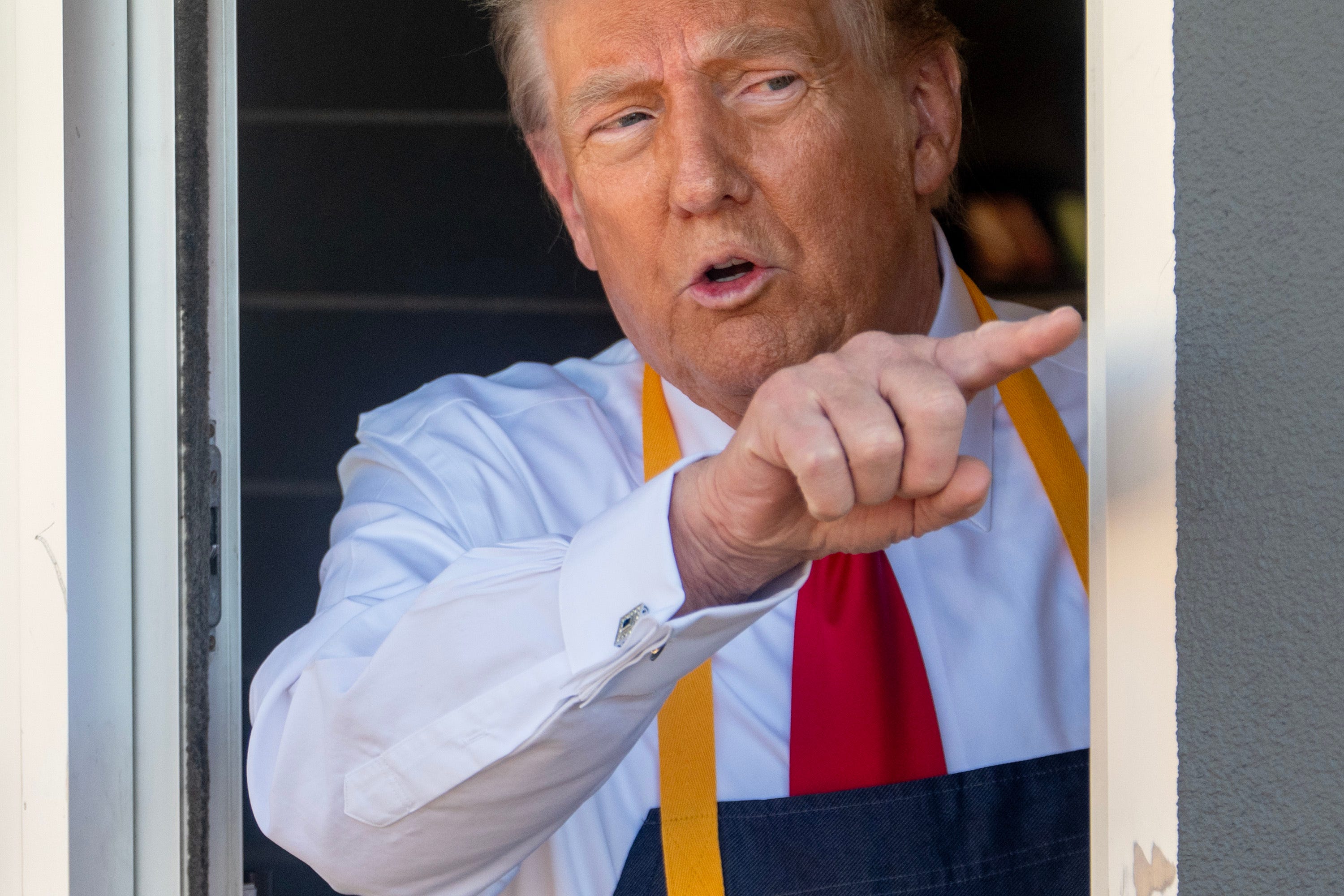
In October 2024, Trump’s campaign turned this irritating kerfuffle into one of the most impactful pseudo-events in United States history. They rented out a McDonald’s location in the aptly named Feasterville, Pennsylvania. Trump put a McDonald’s apron over his shirt and tie and mugged for the cameras while he pretended to work the frier and served food that no one ordered to campaign volunteers pretending to be customers.
That it was a quintessential pseudo-event staged for media consumption was neither concealed nor denied, and many—OK, me—expected this giant exercise in fakery to become Dukakis’ tank. But the fact that everyone could see the fakery behind the facade only worked in his favor.
“We are frustrated by our very efforts publicly to unmask the pseudo-event.”
“We are frustrated by our very efforts publicly to unmask the pseudo-event. Whenever we describe the lighting, the make-up, the studio setting, the rehearsals, etc., we simply arouse more interest,” wrote Boorstin. “Once we have tasted the charm of pseudo-events, we are tempted to believe they are the only important events. Our progress poisons the sources of our experiences. And the poison tastes so sweet that it spoils our appetite for plain fact.”
The more liberals and the news media debunked Trump’s Potemkin shift as a window jockey at McDonald’s, the more interest was drawn to it and thus more attention. The photograph of Trump fake-working at the drive-tru became iconic and perhaps the most-impactful image of the campaign’s last few weeks.
Boorstin would not have been surprised. “There is no way to unmask an image. An image, like any other pseudo-event, becomes all the more interesting with our every effort to debunk it,” he writes. “We are all interested in watching a skillful feat of magic; we are still more interested in looking behind the scenes and seeing precisely how it was made to see that the lady was sawed in half.” Or the billionaire was a working stiff.
“The cost of an error has dropped, while the value of ubiquity has risen.”
Exposés become fake news, and lies become alternative facts. And the point isn’t to be right, or good, or just, but to be more, by which I mean to exist more in online conversations. “The biggest shift in contemporary politics and PR may be that the cost of an error has dropped, while the value of ubiquity has risen. If you talk to everyone all the time, you’ll occasionally say the sort of dumb thing that would have sparked a social media scandal and dinged your stock just a few years ago,” wrote media columnist Ben Smith.
Case in point: According to Magda Muszynska Chafitz, senior director of research at People First, an influencer agency that works with liberal causes and worked with the Harris campaign, the turning point in the 2024 campaign was their debate. That’s the one where Trump beclowned himself by saying “They’re eating the dogs!” and claiming he had the “concepts of a plan” for health care. His performance should have disqualified him, but from that point on he dominated the online discussion, and it kept getting better for him from then on.
Harris closed the campaign with an exquisitely produced event in front of 70,000 people at the Ellipse in Washington, D.C., the crown jewel among many other note-perfect showcases. Trump closed with the messy Madison Square Garden spectacle, MMA fights, Joe Rogan, and McDonalds. As Trump’s pollster told Politico Magazine, “In the year 2024, when we’re all living on our phones, a big speech at the Ellipse vs. Trump at the drive-through, which is going to break through?” The thing made in order to be fake is more real than the real thing recorded and broadcast in good faith.
We want to believe George Washington could not tell a lie.
This isn’t what we want to believe about ourselves. We want to believe George Washington could not tell a lie (even though we’re well aware that the bit about him chopping down a cherry tree was made up whole cloth). We want to believe that when Abraham Lincoln says that you may fool all of the people someone of the time, some of the people all of the time, and some of the people all of the time, that two things are true: There is, writes Boorstin, “a clear and visible distinction between sham and reality, between the lies a demagogue would have us believe and the truths which are there all the time.” And, most troubling, the second thing that we’ve love to be true: Given the choice, we’d prefer the truth.
“Neither of these any longer fits the facts,” writes Boorstin. The thing made in order to be fake is more real than the real thing recorded and broadcast in good faith. Or I should say Boorstin wrote. Boorstin coined the term “pseudo-event” in his 1961 book The Image. America has been heading this way for decades, and this time we can’t even blame the Boomers.
In fact, maybe our Boomer parents were right and television really does rot your brain. (Good of them to prove it by mainlining Fox News, no?) I think we’re all pretty comfortable accepting that social media is optimized to drive us mad, but we might want to remember that television is only less effective at making us nuts. With everything going on, keeping our heads is important, and doing so means we need to be serious about being choosy about where we put our eyeballs. Read books. Take walks. And for goodness sake, just have fun at your wedding. I promise you won’t care about the pictures in a few years until you’re older and realize how good you looked back then.
Jason Stanford is a co-author of the NYT-best selling Forget the Alamo: The Rise and Fall of an American Myth. His bylines have appeared in the Washington Post, Time, and Texas Monthly, among others. Email him at jason31170@gmail.com.
Further Reading
The Big Fake Robot Uprising

Welcome to the weekend edition of The Experiment, your official hopepunk newsletter. If you’d like to support my work, become a paid subscriber or check out the options below. But even if you don’t, this bugga free. Thanks for reading!
How Eddington explains Sydney Sweeney

Welcome to the weekend edition of The Experiment, your official hopepunk newsletter. If you’d like to support my work, become a paid subscriber or check out the options below. But even if you don’t, this bugga free. Thanks for reading!
The Paradox of Imagination

Welcome to the weekend edition of The Experiment, your official hopepunk newsletter. If you’d like to support my work, become a paid subscriber or check out the options below. But even if you don’t, this bugga free. Thanks for reading!
Advice from a Nazi Dissident

Welcome to the weekend edition of The Experiment, your official hopepunk newsletter. If you’d like to support my work, become a paid subscriber or check out the options below. But even if you don’t, this bugga free. Thanks for reading!
Buy the book Texas Lt. Gov. Dan Patrick banned from the Bullock Texas History Museum: Forget the Alamo: The Rise and Fall of the American Myth, cowritten by yours truly.
We set up a merch table in the back where you can get T-shirts, coffee mugs, and even tote bags now. Show the world that you’re part of The Experiment.