
Toy Stories
When it comes to Masters of the Universe and other movies based on toys, is there more than meets the eye?

Welcome to the weekend edition of The Experiment, your official hopepunk newsletter. If you’d like to support my work, become a paid subscriber or check out the options below. But even if you don’t, this bugga free. Thanks for reading!
Back in 2006, I decided at the last moment to take my two sons, then five and three, to an opening-weekend matinee of Pirates of the Caribbean: Dead Man’s Chest, which, come to find out, was not appropriate for kids that young. This was before reserved seating, and by the time we got there the only seats available were in the first row, lousy for watching the movie, but perfect for what happened next.
When the previews started, the screen went black, and what appeared to be a silver mask appeared, and below that a date. That was it—no name, no “In a world…,” nothing but the mask and the date, but it was enough information for my oldest. In the front row, he raised his two tiny fists straight above his head with his skinny arms and yelled out a lusty, “YES!!” to the amusement of the hundreds of teenagers and twenty-somethings. The mask was apparently more that meets the eye; the Transformers were becoming movie stars.

It was all in good fun back then. Johnny Depp’s Captain Jack Sparrow was a riot, and while the fate of the world was supposedly on the line in the Transformers movies, they were as much comedies as action films. And even though the first LEGO movie played with a child’s perspective of how adults live, that film franchise was still primarily about the jokes, especially Will Arnett’s turn as a supremely goofy Batman. No one was taking any of this seriously, and audiences were in on the joke.
Maybe that’s why the news that Universal had hired actor-director Peter Berg (Hancock, Friday Night Lights, Lone Survivor) to turn the Battleship game into a movie offended so many as a cynical ploy by Hasbro to make money. “This is pure desperation,” said director James Cameron. “This degrades cinema.” Last I checked, Cameron’s success as a filmmaker is measured partly by his box-office receipts, but I get it. On its face, Battleship was not art for art’s sake but a naked cash grab.
So we all decided that the movie stank before we got a whiff of it, and critics decided that the movie matched their preconceived notions. “Two-hour infomercial,” wrote The Los Angeles Times. It was, wrote Indiewire, “a movie for people who found the Transformers series too intellectually challenging.”
“There is no way this movie could be an attempt at seriousness,” sniffed The Atlantic, missing the point.
If the challenge for film critics was to outdo themselves in panning Battleship because it was a based on something you buy in the toy section, Berg’s challenge was to take something you buy in the toy section and make a coherent movie about it. Meaning, the movie had to possess a winking self-awareness of its lineage as well as an insight into what makes the toy work.
Berg started by learning that the game’s hook is what’s called a “blind reveal.” As Hasbro’s CEO explained, “That blind reveal, it’s, ‘I don't know everything at the very beginning, and through my moves I unveil my opponent's plans. Over time, I become aware of where they are and my job is to destroy them before they destroy me.’” Or as Berg summarized. “You become desperate to find your opponent and kill them, and that's a pretty good engine for a movie.”
Overlay that with a story about a young man saving the world by growing up and becoming someone people can depend upon, and you have a crowd-pleasing, if critic-offending, worldwide hit. And once I got over my snobbish impulse to write off the movie sight unseen, I liked it, too. (Quick story: Once I ran into Jesse Plemons, who plays a Seaman in Battleship. Instead of mentioning Friday Night Lights or any of his well-regarded work in film and television, I blurted out, “I loved Battleship!” “Wow,” he said. “I never get that.”)
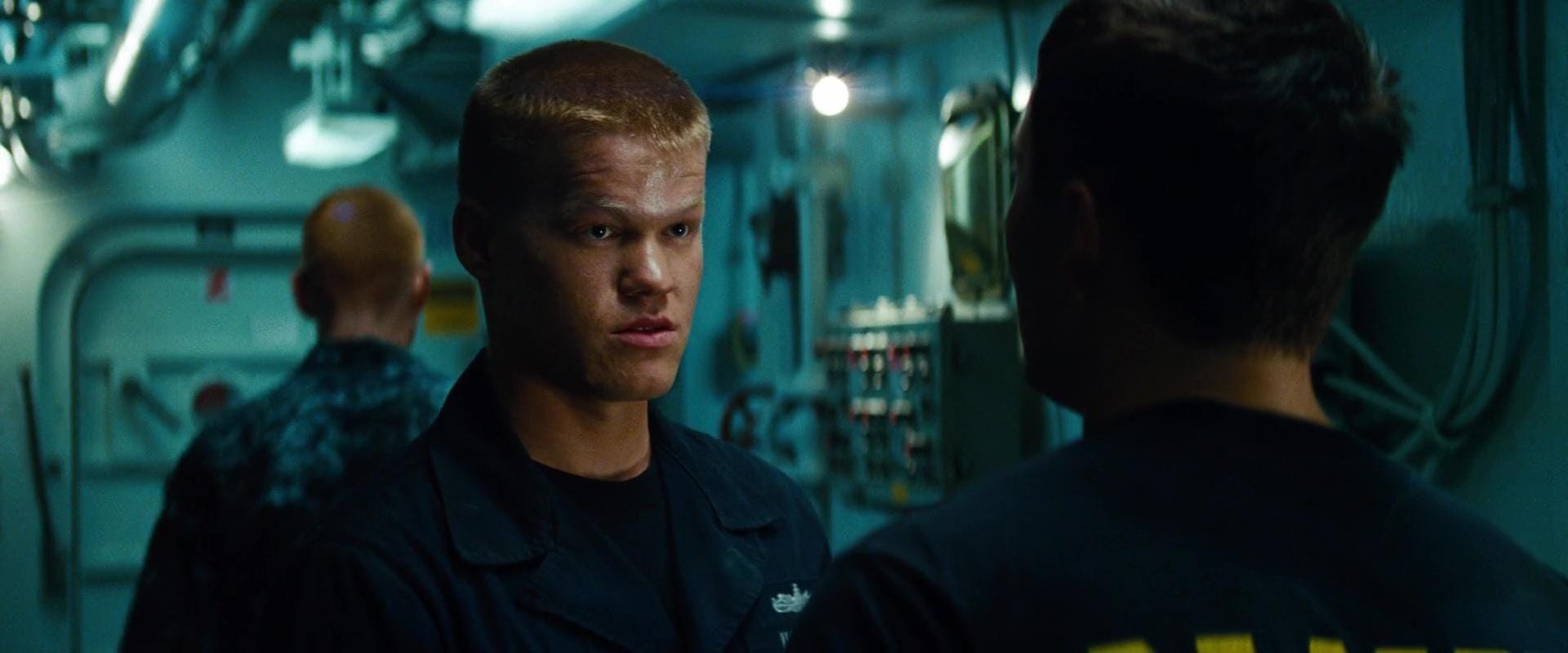
Battleship walked so Barbie could run. Like its nautical forefather, Greta Gerwig’s massive hit also took on that post-Transformers paradox of making a self-aware movie that had a point of view weightier than “Wee! What fun!” But these movies must first overcome that cynical first impression, so much so that making a Kool Aid Man movie was a storyline in Seth Rogan’s super-smart, very-insider television show The Studio. If you wear a cape, have at it. Star in the biggest franchise in Hollywood history. Tell your stories of heroism and valor. But if you’re for sale on a shelf, don’t even think about winning over certain people.
Part of the problem is that we’re talking about toys. We’re all adults here, and toys, well, they’re literal kids’ stuff, child’s play. “When I was a child, I spoke like a child, I thought like a child, I reasoned like a child. When I became a man, I gave up childish ways.” Adults who don’t give up their toys become geeks with collections that only retain value if they are in their original packaging. They lose their value if they are played with, referring here to the toys and not their owners. To an adult, referring to something as a “toy” is a way to denigrate it, like an underpowered truck engine. In graffiti culture, “toy” is a specific insult referring to an unskilled artist, often one who copies the work of others.
Toys might be kids’ stuff, but they played a crucial role in you becoming a grownup. If, as a 2021 study concluded, “The profession of the child is the game he plays,” then toys are the tools a child uses to develop “cognitive, motor, and psychosocial, emotional, and linguistic skills” necessary to communicate with and eventually function in the world. A toy, “which is despised as a ‘child’s toy’ but has a disproportionately serious business,” links the real world inside a child’s mind to the real world we all share with roads, jobs, 7-Elevens, and what-have-you. And it’s only the latter that we grown ups regard as the real world. The child’s real world we call “imagination.”
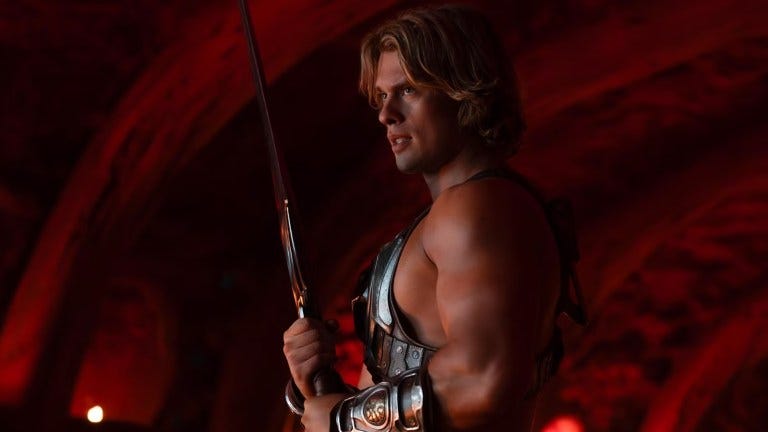
This is why toy movies such as Battleship, Barbie, and the recent Masters of the Universe move back and forth from present-day reality to the reality created by the toy. In Battleship, the toy reality was the ocean off Oahu under the dome created by the aliens, in Barbie it was Barbieland, and in the He-Man movie it was the planet Eterna. Each of these movies could conceivably have been set exclusively in these imagined worlds, but each spends considerable time in our world with us.
This is unlike the Marvel Cinematic Universe or Superman movies, which are set in a world like ours, but with superheroes, and so is not our world but an imagined one. Same goes for Pirates of the Caribbean and Transformers. And so we watch those worlds from our seats as observers from our world and not implicated as we are when the character played by Ryan Piers Williams in Barbie uses Duo Lingo to learn the word “bolígrafo.” (Interestingly—or perhaps not—that actor is married to America Ferrera, who played his wife in the movie.)

Masters of the Universe is the masculinity flip side of Barbie. Skeletor, played hilariously by Jared Leto belittles and blames others, cheats, and—in some of the few moments of unironic emotion—controls an intimate partner by inflicting pain. This guy is a real dick, especially when it comes to women. At one point, he fails to access the powers of the Power Sword, so his hench-woman Evil-Lyn, played by Alison Brie, suggests that he try again, but this time with real emotion.
“Don’t test me, woman,” he warns.
If Skeletor embodies the toxic doucheyness of the manosphere, Adam/He-Man tries to talk through conflict, is slow to judgement, uses empathy first and violence as a last resort. In the climatic fight, Skeletor seems to be fighting He-Man to a draw, so Skeletor, being a douche, makes fun of him.
“Look at you, you feeble worthless child! Yes, you may have the power, but you’re too scared to use it! And you don’t even know how!”
“Trust me, I know how to use it. I just prefer not to,” says He-Man, who proceeds to mop the floor of Castle Grayskull with Skeletor’s face.
Despite this examination of what makes a man, at no point does Masters of the Universe take itself seriously. In fact, the only thing the movie takes seriously is holding onto the fact that He-Man is a toy made for pre-adolescent boys with, let’s say, flamboyantly cartoonish imaginings of what masculinity looks like. It’s a funny movie, but if you’re the sort who gets offended by Pride, you might want to skip it.
But odds are you already have skipped Masters of the Universe because it was based on a toy, and had Barbie not met its cultural moment quite so perfectly or been in the hands of less-skilled filmmakers, maybe you would have skipped that one, too. After all, it was just based on a dumb toy, nothing more than a bit of plastic that children used to develop the inner architecture to build their adult selves, nothing more timeless and necessary to humanity than that.
There might be another toy movie coming. Margo Robbie’s production company, LuckyChap, is developing Monopoly for the big screen. Can’t wait to see what that movie has to say about income inequality and housing. But it’s based on a toy. How good could it be?
Jason Stanford is a co-author of the NYT-best selling Forget the Alamo: The Rise and Fall of an American Myth. His bylines have appeared in the Washington Post, Time, Texas Monthly, and most recently in Texas Highways, among others. Email him at jason31170@gmail.com.
Further Reading
Spending time

The only analysis of Jason Statham’s diving in that movie that you will ever need or that indeed exists at all.

The Horror and Hilarity of Trump's America

In Trump’s second term, it is at once terrifying and farcical to be proud of being American.

Buy the book Texas Lt. Gov. Dan Patrick banned from the Bullock Texas History Museum: Forget the Alamo: The Rise and Fall of the American Myth, cowritten by yours truly.
We set up a merch table in the back where you can get T-shirts, coffee mugs, and even tote bags now. Show the world that you’re part of The Experiment.
Mr. Stanford, did you really write these movie reviews? For starters, the correct spelling is "derring-do", not daring-do. I will assume that you didn't check your work and let AI fuck up your writing. Speaking of AI, the reference to a French phrase for a tiny, fancy appetizer didn't match your analytical skills. It was jarring, it didn't match the trivial nature of a pair of trivial action movies.
I've read your work for a long time. What I see here seems like a rush job to meet a deadline. Please do better.
Respectfully Submitted.