
The Propaganda of History
An excerpt from The White Storm: How Racism Poisoned American Democracy

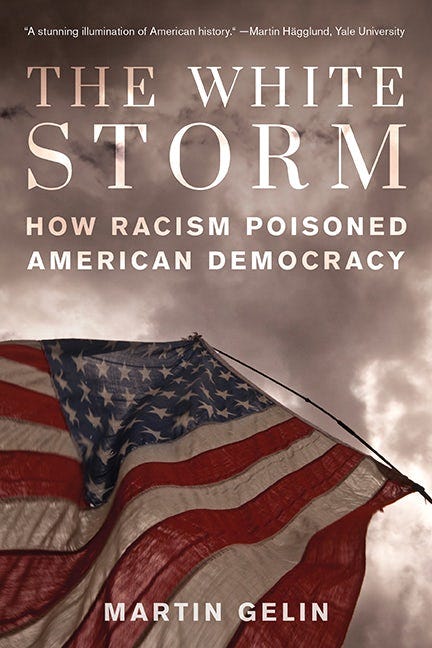
The following is an excerpt from Martin Gelin’s The White Storm: How Racism Poisoned American Democracy, which recently received a starred review from Library Journal. Gelin is a journalist and the award-winning author of eight books on American politics and culture. Since 2011, he has been the U.S. Correspondent for Dagens Nyheter, a national newspaper in Sweden.
The Civil War ended slavery, but it did not end racism. The falsification of Southern history began to be articulated before the smoke had even cleared after the last battles in Richmond and Atlanta. As early as 1866, less than a year after the end of the war, Confederate sympathizer Edward Pollard published The Lost Cause, which condemned Reconstruction as “cultural erasure,” a form of ethnic cleansing from the tyrannical North. Pollard’s choice of the word “lost” cannot properly be translated as a sense of defeat, but rather as something vanished. The word is to be read as in the English translation of Marcel Proust’s masterpiece In Search of Lost Time, where the French “perdu” is transformed into “lost”—a word with multiple meanings. According to Pollard, the South was not defeated, but they had lost something. When Southern nostalgics embraced the term “lost cause,” the goal was to cast a romantic sepia filter over the South’s intentions. Edward Pollard’s book title was likely influenced by John Milton’s Paradise Lost, and Pollard wrote a follow-up book shortly afterward, when the Reconstruction era was over and new laws were established to oppress Black people, entitled The Lost Cause Regained (just as Milton wrote Paradise Regained).
The South viewed the antebellum era as a paradise, an American Eden. While those in the North had to toil and work to achieve their paradise, the South, with its warm climate, fertile soil, and tropical greenery, were able to take the qualities of paradise for granted, in Pollard’s account. From the beginning, this vision was shaped by a fear of losing this paradise, and as soon as the prophecy came true, the fear turned into a nostalgia for the lost paradise. Many in the South, like Pollard, saw the Civil War as a biblical battle that gave meaning to their suffering and paved the way for a belief in their divine restoration.
Moreover, the South believed that it had lost the war because of unfair Northern practices, as the Northern General William T. Sherman had burned down several of their cities, such as Columbia, South Carolina, and Atlanta, Georgia. The South thus still considered itself to be not only morally, but also militarily, superior to the North. They held on to the belief that the North had “won by cheating and using dishonest methods, proving their very moral inferiority,” according to Pollard’s Lost Cause.
The Civil War ended slavery, but it did not end racism.
The choice of words and the idea of a North that engineered a victory over America’s true patriots is strikingly similar to the narrative that emerged from Donald Trump, Roger Stone, Rudy Giuliani, and their cronies and bitter Republicans after Joe Biden’s 2020 election victory. They immediately orchestrated the “Stop the Steal” campaign and explained that Biden’s election victory came from cheating, illegal votes from undocumented immigrants (Trump, it should be remembered, used exactly the same argument to explain how Hillary Clinton had received almost 3 million more votes in 2016). Pollard even claims at one point that the North cheated its way to victory in the Civil War precisely by using undocumented immigrants, “trash from Europe,” as he puts it, exactly the same rhetoric that Trump used after his defeat. The point, then as now, was to attack the very idea of America as a pluralist democracy.
Pollard ends Lost Cause with a plea that the war should not be the end of the “peculiar lifestyle” of the American South. “Peculiar institution” often serves as a euphemism for the institution of slavery in Southern nostalgic narratives, but Pollard is unusually specific. He writes that the unfortunate outcome of the war should not have led to Black suffrage or the end of state self-determination. The ranking of concerns is revealing: The denial of Black voting rights comes before states’ rights. “We have put down the sword but picked up the weapon of argument,” Pollard writes. In other words, the Southern states have lost the war, but they can still win the mythology of the meaning of war. They can win what lawyer and social justice activist Bryan Stevenson calls “the narrative war,” or what is perhaps best understood today as the culture war.
Edward Pollard hoped that after the defeat, despite the hundreds of thousands of dead and despite their proudest cities being burned to the ground, the South would cling to the idea of moral superiority and thus make it impossible to defeat them ideologically. For if their ideas can survive such a bloody and definitive defeat, surely then they can withstand almost anything. “By dying, the Confederacy became immortal,” wrote author Robert Penn Warren, one hundred years later.
Martin Gelin’s The White Storm: How Racism Poisoned American Democracy will be published on January 21 by Prometheus Books / Rowman & Littlefield.
We set up a merch table in the back where you can get T-shirts, coffee mugs, and even tote bags now. Show the world that you’re part of The Experiment.
Buy the book Texas Lt. Gov. Dan Patrick banned from the Bullock Texas History Museum: Forget the Alamo: The Rise and Fall of the American Myth by Bryan Burrough, Chris Tomlinson, and myself.