
How to Write a Commencement Speech
Or at least one that doesn't suck out loud

Welcome to the weekend edition of The Experiment, your official hopepunk newsletter. If you’d like to support my work, become a paid subscriber or check out the options below. But even if you don’t, this bugga free. Thanks for reading!
Graduation season is upon us, which visits upon the land a perennia plague: graduation speeches.
If you think listening to graduation speeches is tough, try writing one. A while back I had to write a commencement address for a very white mayor to the graduating class at an HBCU, i.e., a Black school. I should mention here that I am also very white. I’m the kind of white that likes to mention the single-digit percentage of Native American that shows up in a DNA test. I’m the kind of white that can unthinkingly jaywalk in front of a lot of cops. Like, super white. I realized I was the kind of white for whom writing an HBCU graduation speech was more of a cultural exchange.
I called a friend of mine who graduated from Howard University, another HBCU, for advice. This was when Beyoncé’s Lemonade had just come out, so she advised me to drop in a few references. “Maybe include that line about breaking chains. ‘A winner don’t quit.’ Something like that,” she said.
“Are you sure they’ll catch the reference?” my white ass asked.
They did. Whipped into a languid torpor because of the heat and the speech’s inadvisable length, the graduates perked up immediately when the Mayor said, “Or as Beyoncé put it, ‘I’mma keep running, cause a winner don’t quit on themselves.” Happy cheers erupted. Very briefly and very locally, his unexpected Beyoncé quote went viral. The elderly Black woman on city council called him “the cool mayor.”
More often than not, however, graduation speeches fail because most speakers share a delusion that what they have to say matters to graduates or their parents.
For every Admiral William H. McCraven, who famously advised University of Texas graduates, “If you want to change the world, start off by making the bed,” there are a million forgotten exhortations to get out there and change the world in these uncertain times. McCraven turned his commencement address into a best-selling advice book, but can you tell me what the speaker said when you graduated from high school? From college? When you kid graduated?
The problem is a misalignment of motives. Absolutely none of the graduates or their friends and families got up that morning looking forward to hearing a speech. A commencement speaker is like a comedian at a strip joint. It’s what you sit through to get to the reason you are there in the first place.
But to be asked to be a commencement speaker is an honor that bestows on the recipient the idea that the assembled masses have the slightest interest in what they have to say, which is always at least 16 times as much as even the biggest fan of speeches (Right here! It’s me!) wants to hear (Yes, please shut up seven minutes ago!).
I understand the concurrent impulse to offer advice. After all, you’re important, learned, and accomplished enough to be asked to talk to graduates, who, though intelligent and—as of that exact day—educated, still have much to learn. What luck for them that you can send them on their way with life lessons, or something. Again, they didn’t show up to graduation for advice. They showed up for the closure created by ceremony and a diploma to hold up for pictures with the folks. They do not want, let alone will ever remember, some dude mansplaining their lives to them.
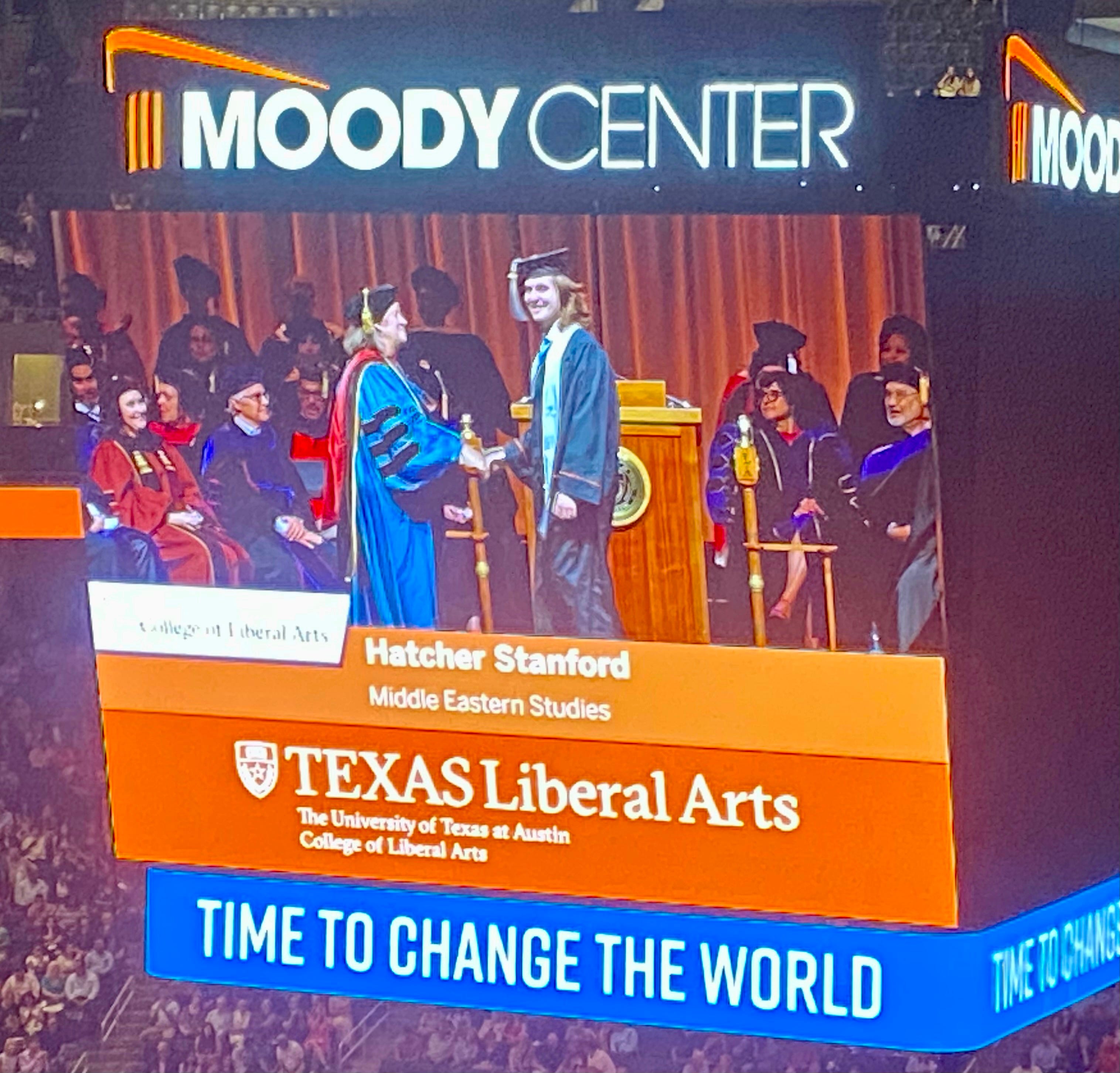
It's possible to do well. YouTube has several great commencement speeches. At my youngest son’s graduation from UT this weekend (as *cough* magna cum laude with highest departmental honors with a degree in Middle Eastern Studies and a Minor in Arabic—the kid rules) retired professor James Pennebaker lightly touted his expertise in analyzing large data sets before getting off the most subtle and successful joke in the history of commencement addresses. “If you look at UT in terms of our students over the last 20 or 30 years, the quality of our students has gotten better every year,” he said. “And I’m very pleased to report that the statistics show that your class was the very best class to be admitted to the University of Texas.”
That joke works because it acknowledges the first secret of a successful commencement address: flatter the graduates. They could get their diplomas mailed to them. They could get their pictures taken with their folks anywhere. They want their moment. Why? Because it feels good. Giving them a serotonin shot brings you in alignment with their motives.
The second secret is to throw flowers at the grandstands: the parents, the grandparents, the stepparents who never knew what they were getting into but kept showing up anyway. This is really for you up there in the bleachers, amirite? Graduates, find your mom in the crowd and wave at her. She’s the one who got you out of bed and made you lunch and then brought it to school when you forgot it. Tonight’s her big night. Do this, and the crowd loves you, because they’re here to feel something, too.
And the last secret is to shut the hell up and sit the heck down. I checked, and exactly no one in the history of the world ever complained that a commencement address was too short. You would look it up, but you’re agreeing with me already.
That’s how you should do a commencement address, yet no one this side of Joe Biden ever has. (Look up his Yale commencement address from a little more than a decade ago. It’s perfect.) You’re an accomplished person. It’s true, I looked at the subscriber list, and it’s like a who’s who of VIPs, which means if you haven’t already, you’re going to be asked to do a commencement address. Now you know how: graduates, you’re awesome, parents, this is your win, adios!
Unless…
Get two fit friends to dress up in dark suits, sunglasses, and earpieces like the Secret Service wears and have them run on stage and drag you away as soon as you say, “I’m not supposed to tell you this, and we don’t have much time, but…”
People might remember that one.
Jason Stanford is a co-author of NYT-best selling Forget the Alamo: The Rise and Fall of an American Myth. His bylines have appeared in the Washington Post, Time, and Texas Monthly, among others. Follow him on Threads at @jasonstanford, or email him at jason31170@gmail.com.
Further Reading
Keep Moving

Did I ever tell you about the time Ted Cruz wrote a letter to the Secretary of Defense warning them not to invade Texas, and my friends Elie Jacobs and Frank Spring and I wrote a response from Sec. Ash Carter to Texas’ very junior senator? Since it ran in

4 Crazy Things I Learned From My Oldest Son

Welcome to the always free, reader-supported weekend edition of The Experiment. If you’d like to support my work, buy my Alamo book, buy some Experiment merch, drop some coins in the PayPal fountain, or become a paid subscriber. But even if you don’t, this bugga free.

"And how are the children?"

Every presidential museum has a subtext. Richard Nixon’s presidential library, for example, so effortfully replicates certain details of the White House that you can’t come away without the impression that he really wanted you to know that he was a real president before the thing that he had

We set up a merch table in the back where you can get T-shirts, coffee mugs, and even tote bags now. Show the world that you’re part of The Experiment.
Buy the book Texas Lt. Gov. Dan Patrick banned from the Bullock Texas History Museum: Forget the Alamo: The Rise and Fall of the American Myth by Bryan Burrough, Chris Tomlinson, and myself.