

Welcome to the weekend edition of The Experiment, your official hopepunk newsletter. I know I promised to write about the real story of the First Thanksgiving, but I ran across an oddity on Texas’ fifth grade reading list that further illustrates the pitfalls of teaching apocryphal histories to children. Fear not, we’ll close that first loop next week. If you’d like to support my work, become a paid subscriber or check out the options below. But even if you don’t, this bugga free. Thanks for reading!
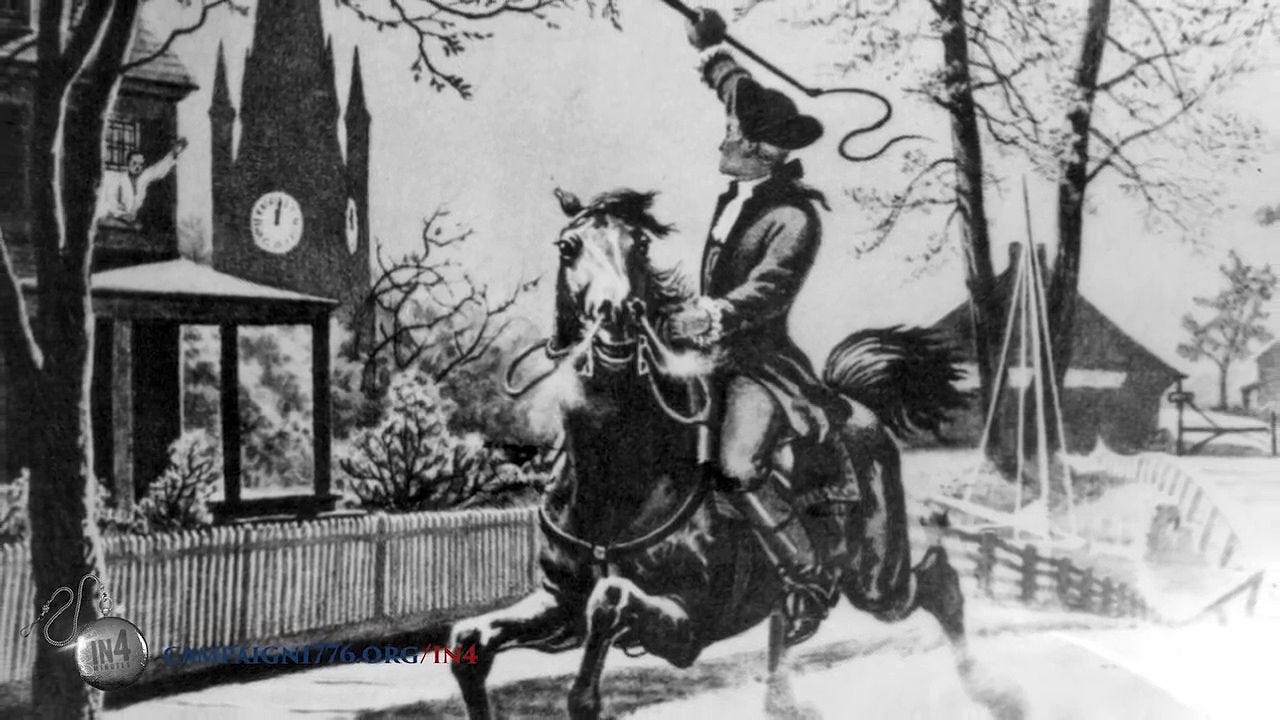
If you know Henry Wadsworth Longfellow’s poem “Paul Revere’s Ride,” you probably think it’s about the American Revolution. I thought so, too, and read it faithfully to my sons at bedtime years ago. And soon, because the Texas Board of Education included the poem on the required fifth grade reading list that focuses on the American Revolution, future generations of Texans will grow up with no clue that what Longfellow was really writing about was the slaveholder’s rebellion we now call the Civil War.
There are numerous factual inaccuracies in the folk ballad easily chalked up to family lore handed down from Henry’s grandfather, General Peleg Wadsworth, under whom Revere fought in the Revolution. Sadly, Revere never shouted out “The British are coming!” and it turns out that he was arrested before reaching Concord. But it is true that Revere rode to Lexington to warn Samuel Adams and John Hancock that British troops were coming to arrest them, based on intelligence that turned out to be faulty. Even so, the British were, in fact, coming, and there was a silversmith named Paul Revere who rode that night to warn people. The poem is true if not accurate.
Why teach “Paul Revere’s Ride” if it’s truthy at best?
So why teach this poem if it’s truthy at best? There’s value in memorizing a poem, and in an era of fractured attention spans, that could do wonders for 10-year-olds. But why this poem?
It’s easy to see why “Paul Revere’s Ride” is, according to Longfellow biographer Nicholas A. Basebanes, the “most memorized poem in American history.” Longfellow wrote himself a banger. The poem’s anapestic tetrameter really moves, giving lines like “One if by land, and two if by sea” a steady, quick momentum. Reciting it can teach how the rhythm of words can effect a horse’s gallop and how then that propulsion can rouse the emotions, but to what end? Class, what do you think the author’s point was? Why is Henry Wadsworth Longfellow trying to get us excited about the Battles of Lexington and Concord, and specifically Revere’s heroic warning?
In the context of a reading list about the American Revolution, 10-year-olds in Texas will have no chance to answer correctly those questions. What’s more, until recently when I read Basebanes’ Cross of Snow: A Life of Henry Wadsworth Longfellow, I didn’t either. And like most of the lies we teach children, the real story is much more fun.
Longfellow was an abolitionist before it was cool. He taught languages and literature at Harvard and was friends with guys like Nathaniel Hawthorne, Oliver Wendell Holmes, and James Russell Lowell, but he never had a closer friend than Charles Sumner, a lawyer with dreams of someday teaching at Harvard himself. Those two were so close that when Longfellow married Fanny, a textile heiress, she invited Sumner on their honeymoon. Sumner, she wrote in her journal, “is perhaps nearer our hearts than any–what a noble nature and how true a soul belong to him.”
Longfellow’s friends liked Sumner, too, that is until he was discovered to be the author of an unsigned hit on longtime congressman Robert C. Winthrop for supporting Texas annexation and the Mexican War, which Sumner opposed because they added slave territory to the states. A “gross disloyalty to Truth and Freedom” is how Sumner put it. For that, he was frozen out of Boston society, and his dream of teaching at Harvard was dead. Some of Longfellow’s friends cut Sumner off, but the Longfellows stuck by him.
“…between the lords of the lash and the lords of the loom”
Sumner, a tall, impressive-looking man who favored brightly colored coats and clashing plaids, didn’t retreat from social disaster. Two years later, Sumner spoke at a political rally to nominate former president Martin Van Buren to run for president again, but this time as a Free Soil candidate. Lots of people gave speeches, but people only remembered Sumner’s, which laid waste to a “conspiracy … between the cotton planters and fleshmongers of Louisiana and Mississippi and the cotton-spinners and traffickers of New England, between the lords of the lash and the lords of the loom.”
Sumner’s oratory—literary, clever, charismatic—and that quotable and damning line— “the lords of the lash and the lords of the loom”—made him an in-demand speaker for abolition. Longfellow wrote that he delivered speeches “like a cannoneer ramming down cartridges,” but to be fair these were deadly serious speeches. As Sumner put it, “You might as well look for a joke in the Book of Revelation.”
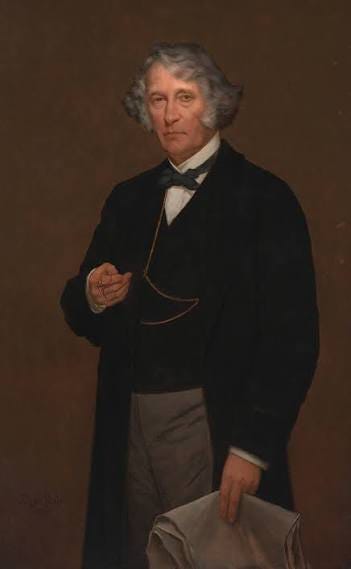
But this made his social situation worse, because those “lords of the loom” were why abolition was not a mainstream opinion in New England. Sumner running, and losing, a race for congress on the Free Soil ticket only made things worse. “With his eyes open to the result, he has destroyed his social position in Boston,” wrote Fanny. “He is there almost a Pariah.”
Sumner swore he was done with politics, but he couldn’t keep his yap shut. There was a pugnacious optimism in Sumner that made him pick fights because he hoped things could be better. Once, at a dinner at the Longfellows’ house, Longfellow showed him the publisher’s proofs of his latest poem, The Building of the Ship. Sumner could not accept that it ended with the ship of state decaying into oblivion. This country doesn’t end like that, Charles lobbied Henry, who wrote a new ending: “Sail on, O UNION, strong and great!”
“He has destroyed his social position in Boston”
When senator Daniel Webster compromised on the Fugitive Slave Act, Sumner let him have it, calling the senator, “Judas Iscariot or Benedict Arnold.” Webster’s defense of the Fugitive Slave Act ended his political career but restarted Sumner’s, who ran for senator as a Free Soil candidate in 1850 and won, defeating the Whig nominee, Robert C. Winthrop. That had to feel good.
Sumner kept at it in Washington, fighting, that is, not winning. He tried, and failed, to get the Fugitive Slave Act repealed. He tried, and failed, to stop Stephen Douglas’ Kansas-Nebraska Act from passing. After that, Sumner scored a victory, perhaps, when he led a coalition of abolitionists and breakaway Whigs to create the Republican Party.
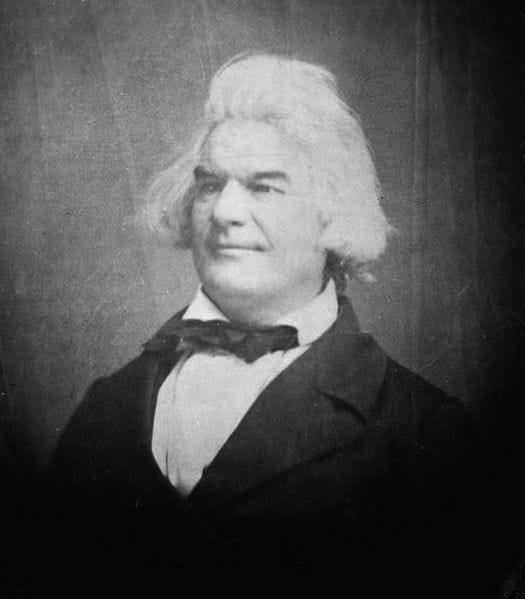
The capitol was a violent place for an abolitionist. If a southern politician felt offended by a northern politician, violence often followed, justified as needing to defend their honor. One senator, South Carolina’s Andrew Butler, even challenged another senator to a duel. And the southerners hated Sumner. Douglas accused him of “abolitionism, free soilism, and ni**erism.” Butler, who often interrupted Sumner’s speeches, went so far as mocking the unmarried Sumner in a senate speech, implying there was something off about a man who practiced chastity.
The flip side of that was that the one thing you could never mention to a southern politician was how slaveholders had sex with their slaves. Everyone knew it happened, but bringing it up in public was considered highly offensive and insulting to white Southerners. So when the Senate was debating whether to admit the pro-slave territory Kansas as a state, that’s exactly what Sumner did.
Over the course of two days in May 1856, three hours one day, two hours the next, Sumner delivered from memory a speech he called “The Crime Against Kansas.” The gallery was packed. Congressmen left the House to listen. Even Douglas, who started off talking loudly to show Sumner contempt, eventually shut up. “No such scene has been witnessed since the days of Daniel Webster,” wrote a New York newspaper.
One of the people in the crowded galley was his good friend Longfellow, who wrote in his journal, “Phi Beta Kappa. A grand, elevated, eloquent elegance from Sumner. He spoke it with great ease and elegance; and was from beginning to end triumphant.”
“the harlot Slavery”
Sumner predicted that admitting Kansas as a slave state was “foreshadowing a … fratricidal, parricidal war” and denounced the South’s “madness for Slavery which should disregard the Constitution, the laws, and all the great examples of our history.”
And Butler, a slaveholder himself? Sumner said he kept an “ugly” mistress—“the harlot Slavery … lovely to him” but “polluted to the world.” He didn’t spell it out, but people got the joke.
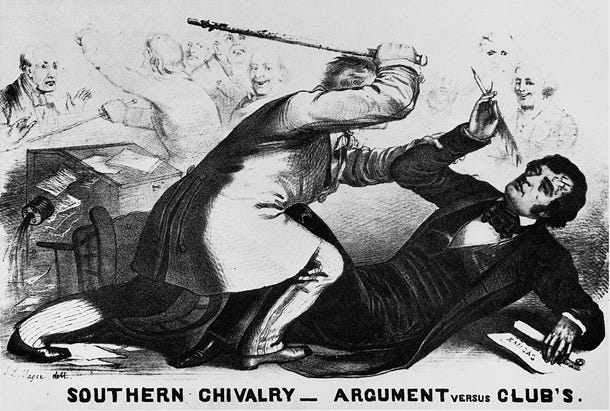
Two days later, Preston Brooks, whose dad was Butler’s first cousin, beat Sumner nearly to death with a gold-tipped, hard rubber walking stick. For Northerners, the attack was proof that Southerners would accept nothing less than Northern capitulation to avoid rebellion. Southerners just thought it was awesome.
Friends rallied to Sumner, whose chair on the senate floor remained vacant for four years. He was even re-elected unopposed while he recovered. “It is the greatest voice, on the greatest subject, that has been uttered since we became a nation,” Longfellow wrote. “No matter for insults,—we feel them with you; no matter for wounds,—we also bleed in them! You have torn the mask off the faces of traitors; and at last the spirit of the North is aroused.”
Inspired, Longfellow decided to get in the fight, though indirectly. The next year he and Ralph Waldo Emerson, James T. Fields, and Louis Agassiz, along with old friends Lowell and Holmes, come up with the idea to create a magazine with “no agenda or canon, with the exception of one unassailable stance: an uncompromising opposition to slavery.” From that, in 1857, came The Atlantic Monthly Magazine.
Longfellow kept in touch with Sumner—two years after the attack, he wrote Sumner “I groan with you about the iniquity of the times. It is deplorable; it is heart-breaking”—but he was hard at work on a new project. The diary of William Bradford had been recently discovered in London after going missing shortly after it was written, and reading it reminded Longfellow of a story old grandpa Peleg told about how their ancestors, Mayflower passengers John Alden and Priscilla Mullins, fell in love.
“You have torn the mask off the faces of traitors”
Longfellow was in the middle of writing New England Tragedies, his Puritan Divine Comedy, but he interrupted that to to bang out The Courtship of Miles Standish. The ballad cast Miles Standish, the Pilgrim’s combative military officer, as an old, ridiculous, and overly sensitive man who leans on his protege John Alden to propose to Priscilla Mullins on his behalf, leading to her once-infamous response, “Why don’t you speak for yourself, John?”
The Courtship of Miles Standish was a massive hit, selling 25,000 copies in two months. When it went on sale in London, more than 10,000 copies were sold in a single day. The Courtship was taught in American schools into the 20th Century and created an indelible romantic triangle in the popular understanding of the Pilgrims that persists among many Americans to this day.
And though Longfellow bragged to his buddy Sumner that The Courtship was doing “very well; and is rather a triumph in its way, considering the hard times,” it was not his best work. Wrote one, “Many of us are familiar with the central story line of The Courtship, but far fewer have read the poem in its entirety, which in a way is a mercy.”
“Better be dead and forgotten, than living in shame and dishonor.”
At the time, though, readers understood The Courtship as political satire. The blundering and boastful Standish was stand-in for James Buchanan, whom Longfellow thought reckless for constantly trying to appease the South. And the handsome Alden, Longfellow’s kin, was the hero. “Better be dead and forgotten, than living in shame and dishonor.” Longfellow, who preferred to comment on the present by telling a story about the past, could not have been clearer to readers in 1858. The South would rebel unless they got their way, and giving in would mean “shame and dishonor” to the North.
Two years later, as Sumner was writing his comeback speech, “The Barbarism of Slavery,” in anticipation of his return to his duties in the senate, Longfellow spent a day in Boston with Sumner’s brother George, a diplomat. They visited Copp’s Hill cemetery, where the Mayflower passengers were buried that first winter, and Cotton Mather’s tomb. They also rang the bells in the tower of the old North Church, where, Longfellow noted in his diary, “were hung the lanterns as a signal that the British troops had left Boston for Concord.” A few days later, Longfellow made another note in his journal: “I wrote a few lines in ‘Paul Revere’s Ride,’ this being the day of that achievement.”
Two things happened on December 20, 1860: South Carolina seceded, and the January 1861 issue of The Atlantic Monthly was published with Longfellow’s “Paul Revere’s Ride.” And Longfellow, who as we know preferred to comment on the present by telling a story about the past, ended the poem ostensibly about the Revolution with a warning to his countrymen about what they faced at that moment with the South in rebellion.
For, borne on the night-wind of the Past,
Through all our history, to the last,
In the hour of darkness and peril and need,
The people will waken and listen to hear
The hurrying hoof-beats of that steed,
And the midnight message of Paul Revere.
“Paul Revere’s Ride” is about the Civil War.
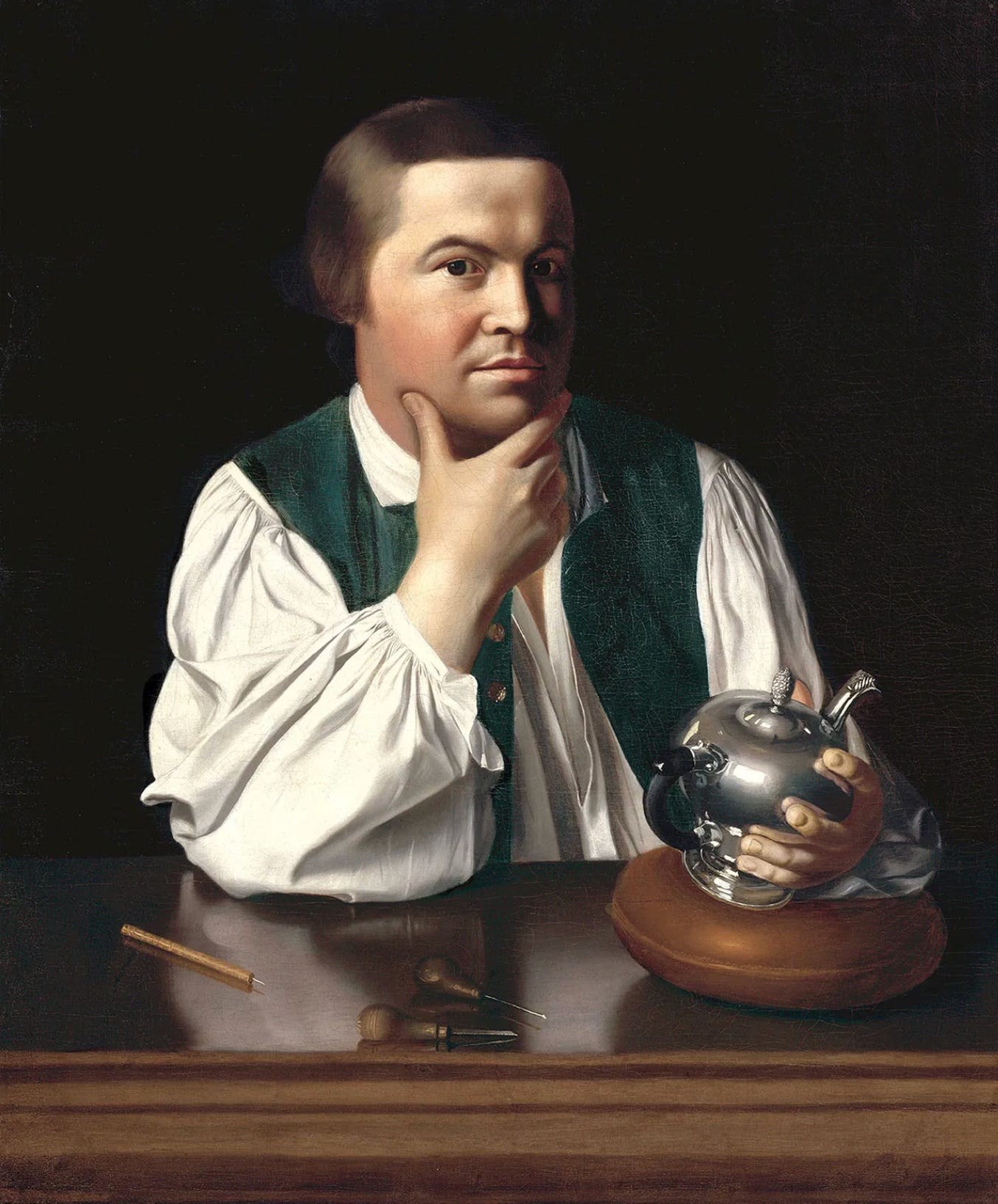
The war made irrelevant Longfellow’s warning, after which “Paul Revere’s Ride” became, literally, kids’ stuff, and as Harvard historian Jill Lepore wrote, “For a poet’s literary reputation, to be read by children—and especially to be loved by children—is the sweet, sloppy kiss of death.” Not only the poem was judged no longer worthy of adult critical thought, but Longfellow himself. As minister and professor of morals at Harvard Divinity School Rev. Henry Gomes put it:
“Had Henry Wadsworth Longfellow devoted himself to the Romance languages, of which he was Smith Professor at Harvard, rather than to mediocre but memorable verse, the perception of American history may well have been quite different. Paul Revere would be little more than an unknown Boston artisan, and the Pilgrims of Plymouth would be little more than aggregate virtue. It was Longfellow’s disciplined meters and undisciplined history that launched them both into immortality.”
By mandating a reading list steeped in the classics, the conservatives on the Texas State Board of Education are rebelling against the sneering contempt of the intelligentsia in academia. Which, cool, but they’re compiling a bookshelf of greatest hits without the slightest understanding of what they’re doing. “Paul Revere’s Ride” was not written for children, but relegating the poem to a fifth grade reading list bleaches it of Longfellow’s intention and the ballad’s real meaning.
I mean, do we really want to teach 10-year-olds to stand up to bullying fascists? Is it in our best interests, “in our hour of darkness and peril and need,” to instill in successive waves of children the duty to rise to the defense of their neighbors against illegal, state-sponsored violence? There might not be a single fifth grade teacher in the entire state of Texas who knows the backstory of “Paul Revere’s Ride,” but the Texas State Board of Education just unwittingly made an anti-fascist tract required reading for 10-year-olds, and I guess I’m just going to have to accept their decision.
Jason Stanford is a co-author of the NYT-best selling Forget the Alamo: The Rise and Fall of an American Myth. His bylines have appeared in the Washington Post, Time, Texas Monthly, and most recently in Texas Highways, among others. Email him at jason31170@gmail.com.
Further Reading
Stop Teaching American Apocrypha

We are about to make the same mistake they made in the 1800s. In a country where almost half of us don’t know that America’s 250th celebrates the adoption of the Declaration of Independence, civic ignorance is so pervasive that we should avoid lying to children to teach them to tell the truth. The danger is that they grow up with the mistaken understanding that those lies constitute their history.
Part 1/3: The Bible Stories Aren't the Problem

I want all children, and especially those from different backgrounds, nationalities, and religions, to know that they share in this inheritance as well. And when these touchstones are referenced, I’d like a graduate of a Texas public school to respond more intelligently than “huh?”
What No One Asks About Vouchers

The students who use vouchers do not end up learning more than their peers in public schools. In fact, “some of the largest academic declines ever apparent in the education research record, on any topic, have been attributable to school vouchers,” writes Josh Cowen in the preface to his book The Privateers: How Billionaires Created a Culture War and Sold School Vouchers, which Kirkus called a “well-researched book for the public policy crowd.”
"Pacto del olvido"

Not only has Russia perverted Germany’s Vergangenheitsaufarbeitung to criminalize history that is literally politically incorrect. Recently, some dude indicted in Russia for blogging that the Soviets and Nazis originally invaded Poland as allies, which is true, but illegal to point out. And like a bad kopek, anti-American sentiment that starts in Russia ends up in Texas, where lawmakers recently created The 1836 Project to promote a “patriotic” version of Texas history. Picture South Africa’s Truth and Reconciliation Commission, but the complete opposite.
Convergence

The book is being treated not just as a collection of information but an actor with agency, in this case a threat to the foundational story of Texas. A writer for One American Network falsely mischaracterized the book as a “a new initiative called ‘Forget the Alamo.’” A state lawmaker, citing the Time article Bryan and I co-wrote, tweeted, “Our Texas exceptionalism is a threat to their radical agenda, which is exactly why we must fight to protect our sacred history.”
Buy the book Texas Lt. Gov. Dan Patrick banned from the Bullock Texas History Museum: Forget the Alamo: The Rise and Fall of the American Myth, cowritten by yours truly.
We set up a merch table in the back where you can get T-shirts, coffee mugs, and even tote bags now. Show the world that you’re part of The Experiment.
Aside from duels being accepted in the old days, it shows people far worse than the Capitol rioters were also accepted: i.e. the guy who inspired "Paul Revere's Ride" tried to kill someone, a la the Afrikaner Hitlerite who was assassinated in C.E. 2013, and the Greater Southerners illegally seceded without trying to claim a gradual end to slavery would result in higher crime rates, labour uprisings, feuds involving Natives and other free people of colour, and slave rebellion in states which did not abolish slavery, with the greater Southerners failing to try to defend slavery through religion or by claiming slaves were descendants of convicts or non-Christian warrior societies. I see you also admit rightists are right to be angry at the right-wing Bohemian Bourgeois who are to the left of the New Democrats but right of H. Ross Perot supporters. Of course the rightists are too stupid to know the historical context of Henry Wadsworth Longfellow. They also ignore the influence from "The Kalevala" which does NOT advocate the Germanic love of combat and destruction which culminated in pogroms, slavery, the Age of Exploration, the democide of indigenous peoples, the Whiggishness of the brutal Roundheads who were dominated by gentry and esquires and squires and the bourgeoisie, Lamarckianism, and New Imperialism, ultimately culminating in the Kaiser convincing the genocidal Young Turks to declare jihad, the Holocaust and beforehand the brutal executions in the concentration camps starting in C.E. 1933, the Cold War, and the fight against terrorism and rogue states which resulted in the War on Terror and its escalation into fighting narcoterrorism, the continued militarization of police, and the fight against warlords and pirates.
"The Kalevala" opposes vengeance - a la Kullervo's vengeance -and advocates action only when needed i.e. the need to retrieve the Sampo. It is this that is referred to in "The Hobbit" when Thorin, named after a Germanic dwarf, says to Bilbo, who being a member of the Little People is based on Germanic and Celtic folk memory of pre-Indo Europeans - related distantly to Uralic peoples like the Finns, whilst dwarfs seem to be based on relatively warlike Mediterranean people like the North Africans and Levantines - "if people valued food, laughter, and good cheer instead of hoarded gold, the world would be a merrier place."